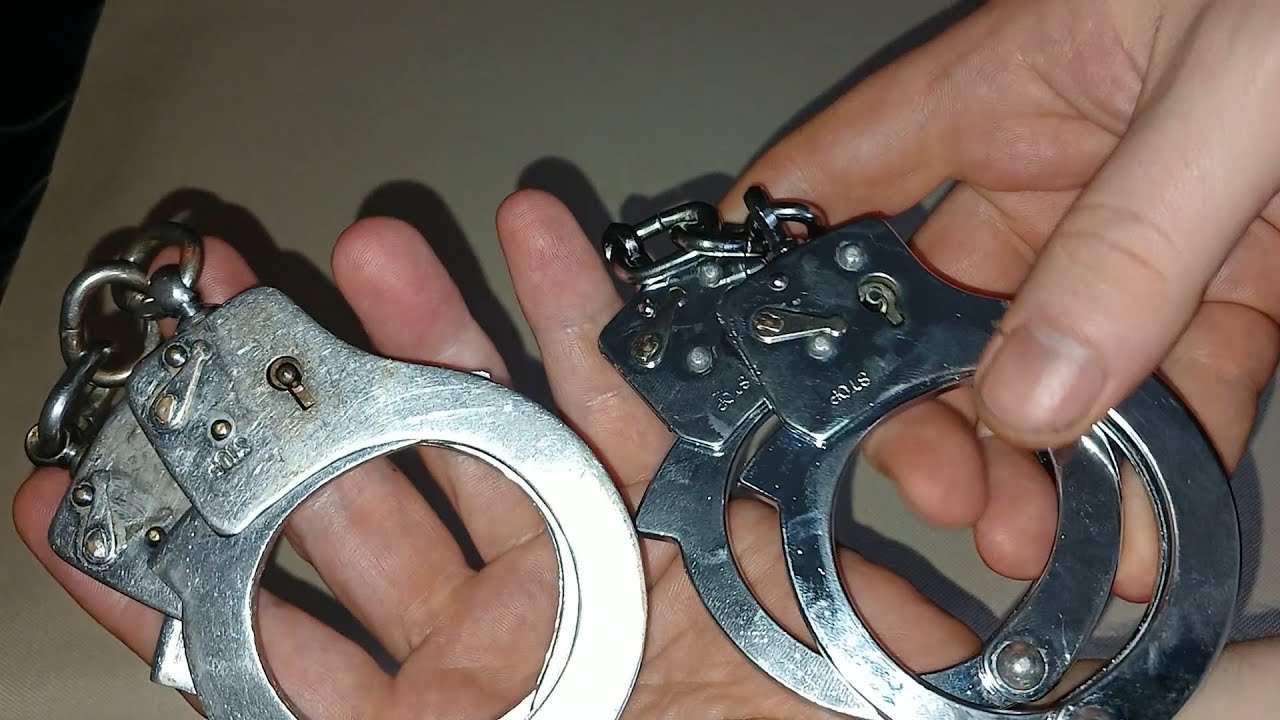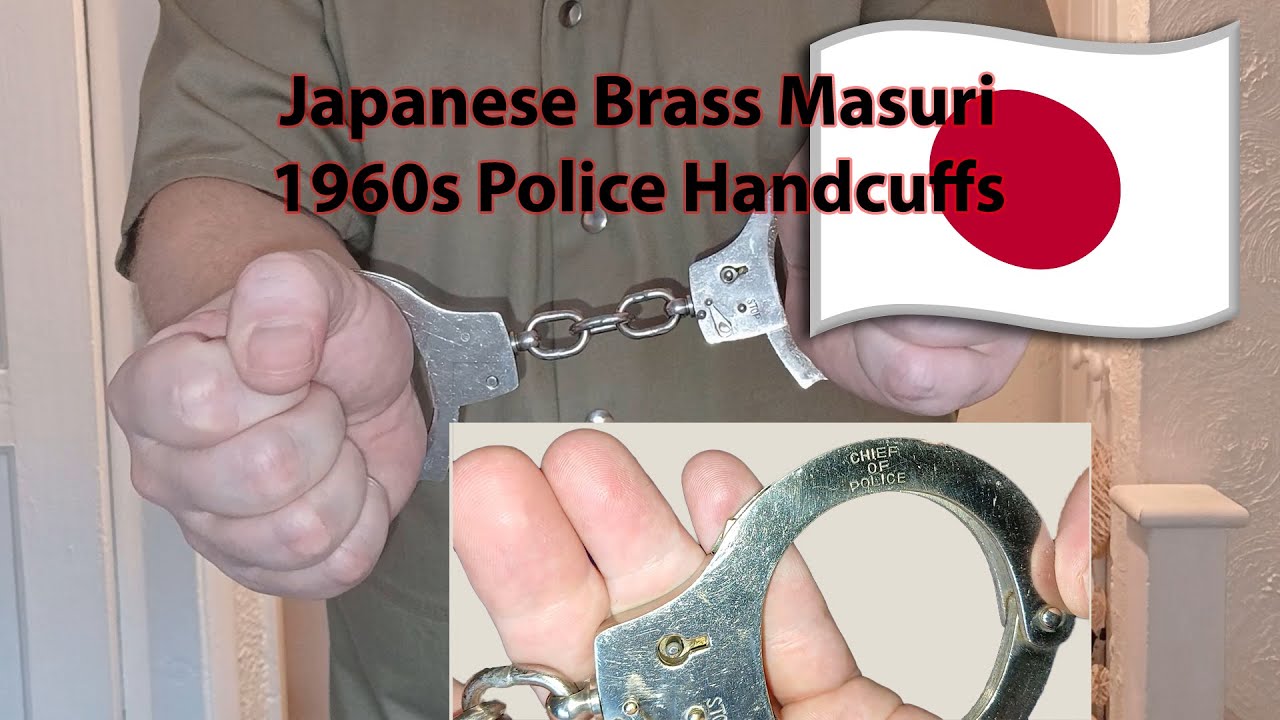
This is a video primarily about the Brass Masuri Japanese 1960s police handcuffs. This design dates back to WW2 according to Alex Nichols' great books on handcuffs. These are not toys! , they are genuine police handcuffs.
The handcuffs shown in the video are 1960s Brass Masuri, 1980s Steel body Masuri, Steel body Takeda. The Brass Masuri are the main focus of this video and description. They are either nickel or chrome plated.
When you see these handcuffs, you probably think "They're toys" and that is because this style has been copied for years for the mass-produced toy market in China. These Masuri are the earliest brand known that made them and they are identical to a pair taken from a Japanese soldier in WW2.
This pair has "CHIEF OF POLICE" and "MONTE CARLO" stamping. It is not known if this means they were destined for Monaco police or if merely the association with the bustling rich casino locale was just a far-eastern marketing strategy to make them more appealing.
They have a pin wheel mechanism instead of pawls and are unshimmable. They do double lock with a stiff lever, which while provides no real liability protection for the user, it does serve the purpose of preventing accidental over-tightening better than any other version. Since this is the older brass model, it has a curtained keyway which is like a C shape cup, so you can insert the key and turn and the curtain / cup turns with it. This means picking them open is much harder because you cannot just shove a tool in and work with the mechanism, you need to precisely turn the curtain to the right position so that the opening would give you access to the keyway. And the keyway does not have much room to work with!
During Aparthide in Rhodesia (now Zimbabwe) they were under heavy sanctions and weren't able to get the latest and greatest security hardware from the west and elsewhere. So they used various handcuffs, including a steel version of these Masuri that I featured before and mistakenly referred to as Takeda. The steel model would have been cheaper because it uses stamped steel rather rather than all brass and is much cheaper and quicker to manufacturer. The steel versions are similarly great quality, though they lack the keyway curtain. But are still good quality handcuffs.
I concluded my previously featured steel pair and these Brass ones are both Masuri because of several factors. The quality is exceptional in both. Both have the same JAPAN stamp in the same location, with the same font, in the same size. On the back section, there is only one prominent artifact which is the base of the double lock lever's rotational pin. Both have 10 holes in the bow for sizing. Both have nicely welded chain links. On the other hand, the Takeda mentioned next have 9 holes, 4 prominent artifacts on the back, very shoddy construction, gaps between the body and cheek plate and a JAPAN stamp on the back, which is in a different font and different location, both matching what Alex's book shows for Takeda.
Then came along Takeda and copied the Masuri handcuffs and made them even more cheaply. Stamped steel bodies, still a brass bow, poorer construction, sloppy tolerances, thinner gauge material, poorly welded chain links (just on the corners of the poorly mated link ends) and the double lock levers have no stiffness, at least in my pair. These were later copied by China as toys. In fact in the 1990s I had such toy handcuffs as a kid, ones without the safety release on.
Weights:
Brass Masuri: 304 grams
Steel body Masuri: 278 grams
Steel body Takeda: 240 grams
And for comparison, modern decent quality toy versions, like Viper Tactical (in the UK) are 215 grams.
I believe the key I received is not the original key (I have seen several pictures to see the difference) but in fact is a Takeda key that works fine, slightly snug but works.
The on-body demonstration only shows these newly acquired Brass Masuri from the 1960s. I won't bother making a video on the actual Takeda since a) they are quite poor quality by comparison, look so similar to these and the previous Masuri and I have shown them at least in this video in the comparison.
Enjoy!