A blog showing videos of handcuffs, various brands and models such as Smith & Wesson, Peerless, Yuil, ASP, Clejuso and more.
• Click "Older Posts" under the last video listed, to see the next page of videos :)
Showing posts with label chain-linked. Show all posts
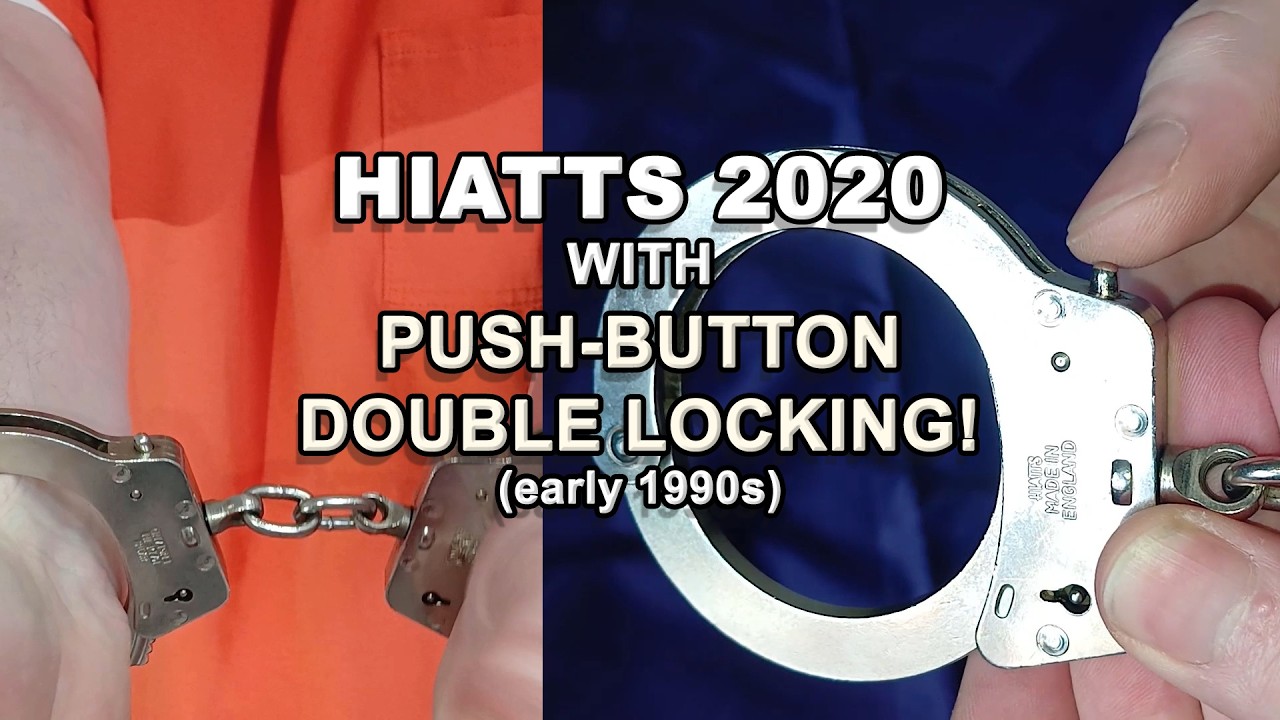
Quite Scarce HIATTS Model 2020 British Chain Handcuffs With External Push Button Double Locks!
These are the HIATTS 2020 chain-link handcuffs with external push buttons for the double lock. They are very, very early 1990s, given that it is a classic HIATTS 2010 design with leftover swivels from the prior 1980 model.
It was a bold experiment, to increase the ability to double lock the cuffs in a hurry without having to use the back end of the key. But it had an unforeseen detrimental effect. The handcuffs could accidentally double lock while in the case on the officers belt or even while gripping the handcuffs to apply them. This means you pull the handcuffs out to secure a criminal... and they won't go around the wrist. Or as you are applying them, you get a couple of clicks or so around their wrist and your grip presses the double lock and they won't properly tighten. Very inconvenient when struggling with a criminal and you have to unexpectedly dig your key out, undo the double lock and re-single lock the cuffs without doing the same mistake again!
These are not a very common item, because they weren't deployed widely, after these issues were noted. Usually cost more than a regular surplus pair of HIATTS 2010, at least 2 or 3 times the cost. I got mine for less than half price of what I would pay for a 2010!
Also, this is the first appearance of my genuine US prison Bob Barker brand orange 2-piece prison scrubs in a video. Plain prison clothing like this in Khaki or orange, provide a nice plain background that is bright enough, with no distracting patterns or dark colours that reduce restraint visibility. This way, you can more easily see the handcuffs or leg irons that are being shown in a worn context, compared to back in the day when I wore my usual black clothing. After all, the items are the only star of my videos! Plus the clothing is a good match for the context of the usage of restraints.
Please like and subscribe.
Enjoy!
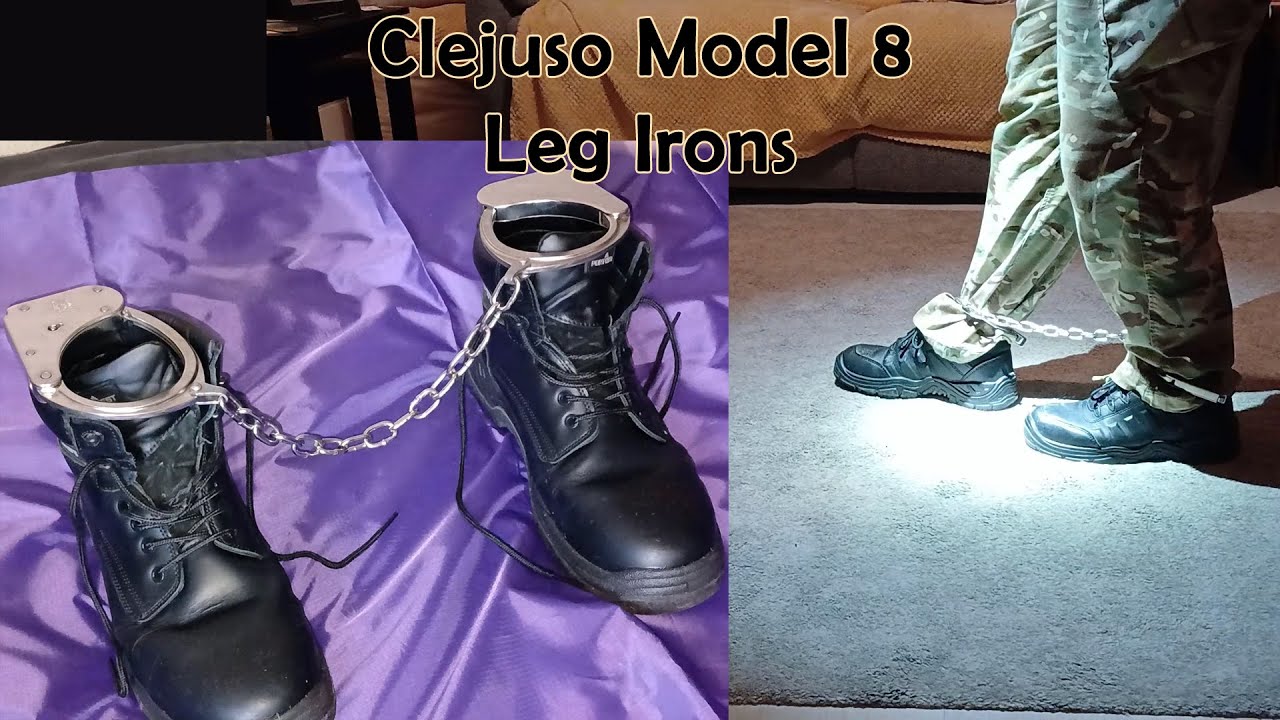
Clejuso model 8 leg irons from Germany
These are German leg irons from Clejuso, model 8.
These are made from Zamak material rather than steel, similarly to their model 13 and 15 beefy handcuffs. It's a strong zinc alloy, but requires more bulk of the material to off-set it's lack of inherent strength that steel would have. This produces a strong restraint that is not as heavy as a solid steel one would be.
They have a steel chain and the internal mechanism, except the spring, are also Zamak alloy. The springs are presumably steel.
They are not swing-through, but they have a double lock, as you would expect for safety and security reasons. It's basically like a HIATT 115 Scotland Yard handcuff, made larger for legs, with a double lock added.
The chain is short (just slightly less than 30cm long, which means your walking stride has to be significantly shorter than normal a normal walking pace. Also, the design of them is not super comfortable and if you try to walk faster, the rotating of the shackles can cause discomfort. So walking in these is much slower than normal. British Darby leg irons are more comfortable because of the more rounded shape means they can turn naturally around your ankle without causing pinch points, whereas these German ones do cause discomfort IF you try to walk faster.
The cheek plate has a lip on the inside, acting as a ward that protects the double lock. You cannot use a Clejuso model 13 or 15 key to disengage the double lock because the lip blocks you. The double lock could be picked open with a long, strong and bent tool, but I have not experimented much, because I cannot simply replace these leg irons in the UK if I were to break them. The single lock is easy to pick using a parker jotter pen clip or similar strong bit of thin metal.
It is not apparent at first glance but there is a right and wrong way to apply these. The clasp that connects the chain to the shackle has a tilt. They need to be worn with the clasp on the front-facing side with the angle pointing inwards. If you try any other method, the chain is further shortened and trivially creates much more discomfort and awkwardness while walking.
The small length of the chain, like the British Darby leg irons, means than standing with your legs together does not drag the chain all over the floor or make loud clacking noises as you walk, since the chain does not touch the floor while walking. This helps protect the floor from having steel chains scraping across it as the person walks.
All in all, this is a high quality and effective leg iron walking restraint.
Enjoy!
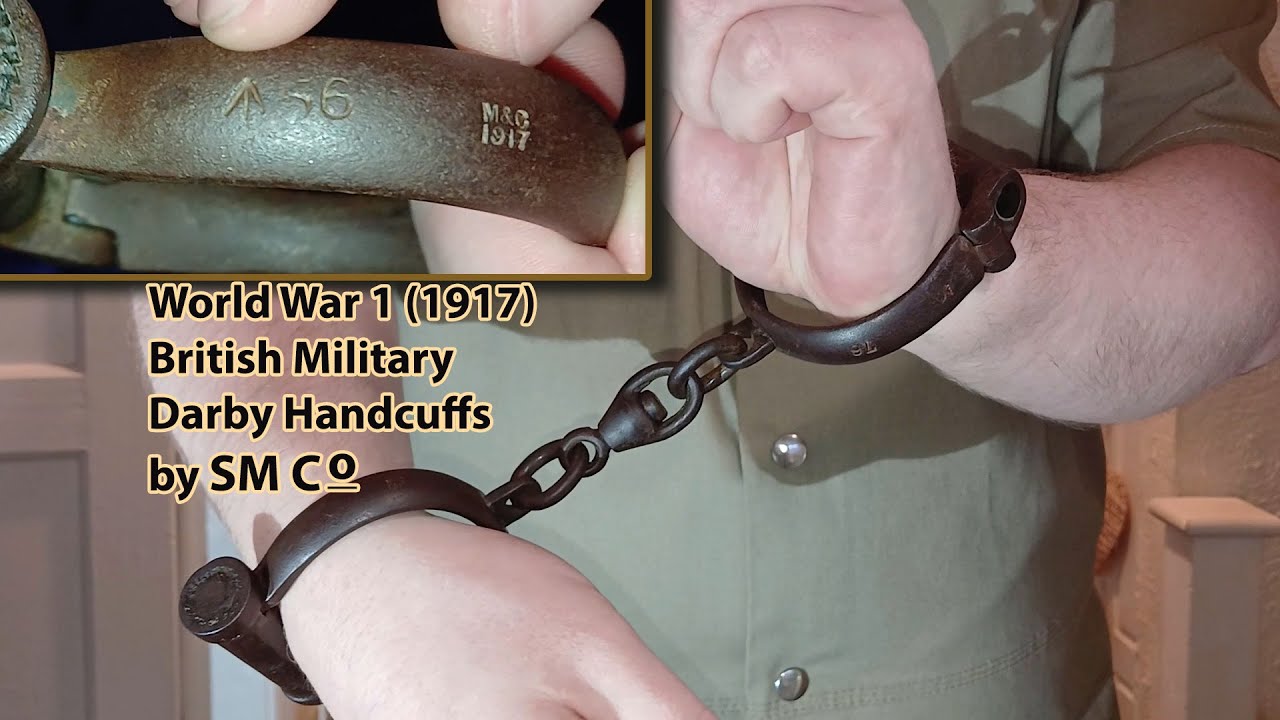
Scarce SM Co Darby WW1 Great War British Military M&C 1917 LARGE Handcuffs with Broad Arrow
These are a pair of British MIlitary SM Co (Security Manufacturing Company) pair of HIATT 104 style non-adjustable Darby handcuffs From WW1.
SM Co are only known to have made handcuffs during the first world war, to fulfil government contracts when other manufacturers could not keep up with the demand. These are stamped with the official British military Broad Arrow or Crows Foot stamp, as well as M&C which was a military and government marking of the day. M&C likely stood for Ministry and Civil or Military and Civil. So to have M&C AND also the Broad Arrow is always cool! Dated 1917, as per the stamp. M&C 1917 is stamped very small!
They are a Size 3 large size... If I can spin my wrists around in them, they're big... ! 403 grams in weight. There would be many reasons for handcuffing during The Great War, such as internal soldier discipline if they had tried to desert, or got drunken or such things as well as for prisoner transport.
I had to do some usual maintenance on them. Using Autosol to remove the surface loose red rust to let the dark patina show through, blasting with fully evaporating brake and clutch cleaner, brushing, re-lubricating etc. But once I had finished (and waxed them of course!) they are a really nice pair of handcuffs. And they came with 2 keys! Fully, legitimate working keys. I am very impressed.
Have these been in the trenches subjected to gas attacks, apprehending German military officers? Have they been re-purposed during WW2 or given to reserve units like the Home Guard? Impossible to tell. I was unable to obtain their history because the seller had no direct ties to the original owner.
They work smoothly. This is the first SM Co brand of handcuffs in my collection.
Enjoy!
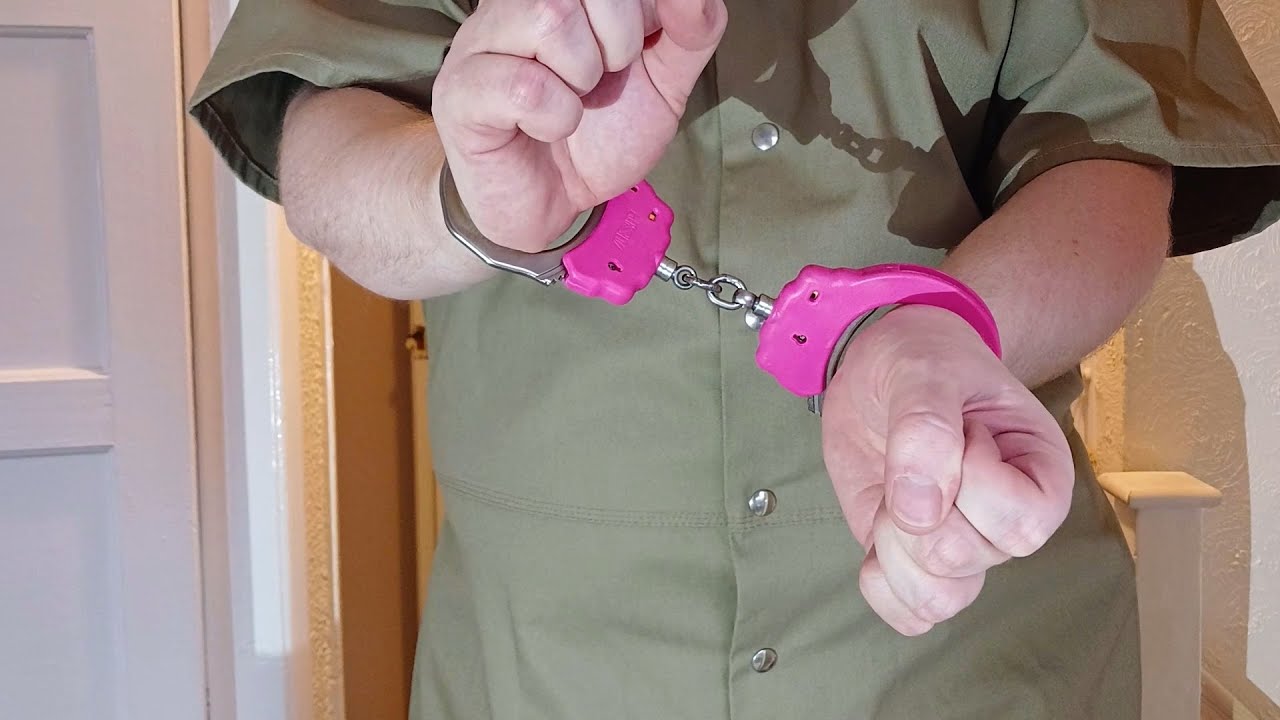
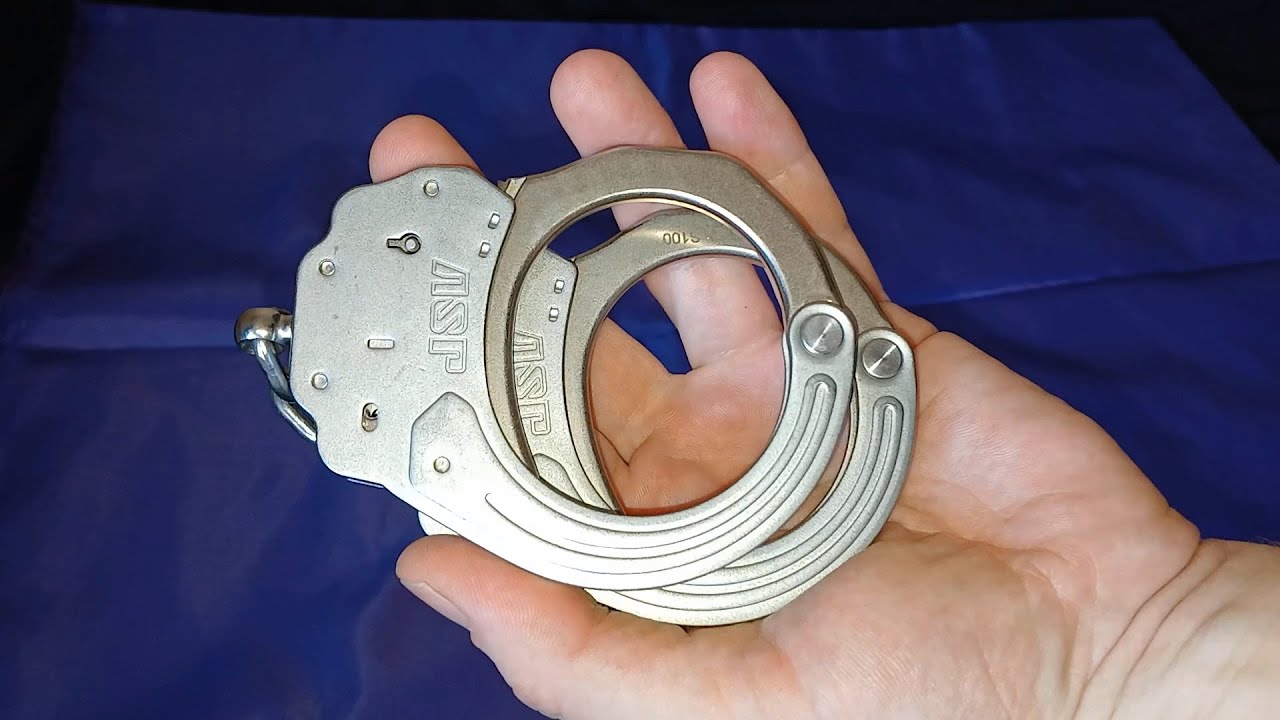
ASP model 100 Identifier Pink Police Handcuffs
This is the old polymer overmold ASP model 100 identifier handcuffs in pink.
They consist of a thin but strong steel skeleton with pink ordnance-grade strong polymer molded over them. They have the yellow single pawl mechanism.
Like all ASP handcuffs they have nice quality of life and safety features such as a flat wrist contact point for application, smooth operation, double locking via the window or the keyway, a single turn disengages the double lock and the single lock and all the surfaces are smooth to reduce the chance of injury.
This is an older model, which came out in the early 2000s and was eventually discontinued when they came out with their Ultra Cuffs, which were made of aluminium to address some issues.
What issues did the model 100 have? Well, because of their bendiness the bow could over-shoot the cuff body and not engage with the pawl, giving a false sense of having applied them to the wrist. Also of an officer fell over onto the cuffs during a struggle with a suspect, the double strand could crimp together and render the cuffs inoperable. The Ultra Cuffs addressed these issues by making the body from solid aluminium.
Being pink in this case, they are fitting for use during breast cancer awareness month (October) and coloured models like this also for officer personalisation, as well as correctional use to denote risk levels and health conditions of inmates etc.
These are really nice and sought after by people for less than law enforcement uses... because of how colourful they are. Since the whole body of the cuff is covered in the polymer, you get a nice brightly coloured handcuff that has less coldness to it, which is in particular more attractive for uses in the bedroom I would imagine!
All in all, they are great NIJ rated legitimate law enforcement handcuffs of the past. Very comfortable and secure when applied properly. All ASP handcuffs can be easily picked and shimmed, which means it's important for LEO use, that suspects are properly searched to deny them access to keys and picking tools.
Enjoy!
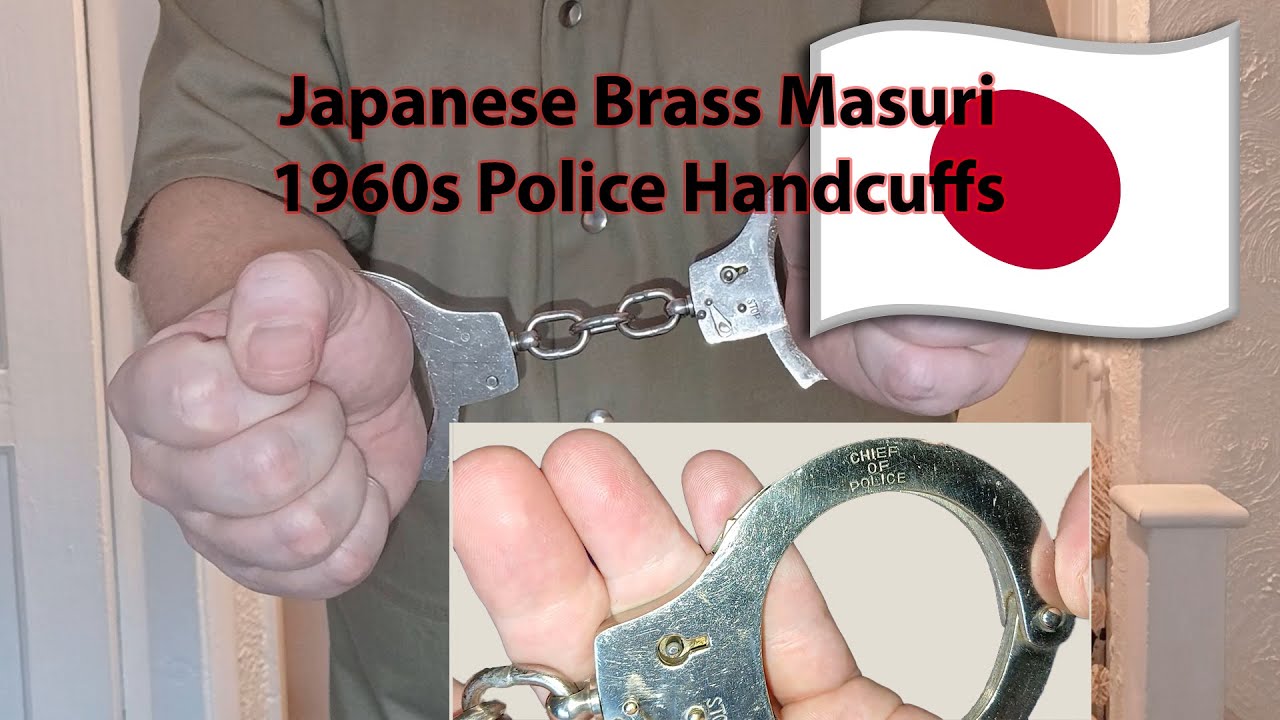
Japanese Masuri 1960s Brass Handcuffs (WW2 Design) with keyway curtain security & comparisons
This is a video primarily about the Brass Masuri Japanese 1960s police handcuffs. This design dates back to WW2 according to Alex Nichols' great books on handcuffs. These are not toys! , they are genuine police handcuffs.
The handcuffs shown in the video are 1960s Brass Masuri, 1980s Steel body Masuri, Steel body Takeda. The Brass Masuri are the main focus of this video and description. They are either nickel or chrome plated.
When you see these handcuffs, you probably think "They're toys" and that is because this style has been copied for years for the mass-produced toy market in China. These Masuri are the earliest brand known that made them and they are identical to a pair taken from a Japanese soldier in WW2.
This pair has "CHIEF OF POLICE" and "MONTE CARLO" stamping. It is not known if this means they were destined for Monaco police or if merely the association with the bustling rich casino locale was just a far-eastern marketing strategy to make them more appealing.
They have a pin wheel mechanism instead of pawls and are unshimmable. They do double lock with a stiff lever, which while provides no real liability protection for the user, it does serve the purpose of preventing accidental over-tightening better than any other version. Since this is the older brass model, it has a curtained keyway which is like a C shape cup, so you can insert the key and turn and the curtain / cup turns with it. This means picking them open is much harder because you cannot just shove a tool in and work with the mechanism, you need to precisely turn the curtain to the right position so that the opening would give you access to the keyway. And the keyway does not have much room to work with!
During Aparthide in Rhodesia (now Zimbabwe) they were under heavy sanctions and weren't able to get the latest and greatest security hardware from the west and elsewhere. So they used various handcuffs, including a steel version of these Masuri that I featured before and mistakenly referred to as Takeda. The steel model would have been cheaper because it uses stamped steel rather rather than all brass and is much cheaper and quicker to manufacturer. The steel versions are similarly great quality, though they lack the keyway curtain. But are still good quality handcuffs.
I concluded my previously featured steel pair and these Brass ones are both Masuri because of several factors. The quality is exceptional in both. Both have the same JAPAN stamp in the same location, with the same font, in the same size. On the back section, there is only one prominent artifact which is the base of the double lock lever's rotational pin. Both have 10 holes in the bow for sizing. Both have nicely welded chain links. On the other hand, the Takeda mentioned next have 9 holes, 4 prominent artifacts on the back, very shoddy construction, gaps between the body and cheek plate and a JAPAN stamp on the back, which is in a different font and different location, both matching what Alex's book shows for Takeda.
Then came along Takeda and copied the Masuri handcuffs and made them even more cheaply. Stamped steel bodies, still a brass bow, poorer construction, sloppy tolerances, thinner gauge material, poorly welded chain links (just on the corners of the poorly mated link ends) and the double lock levers have no stiffness, at least in my pair. These were later copied by China as toys. In fact in the 1990s I had such toy handcuffs as a kid, ones without the safety release on.
Weights:
Brass Masuri: 304 grams
Steel body Masuri: 278 grams
Steel body Takeda: 240 grams
And for comparison, modern decent quality toy versions, like Viper Tactical (in the UK) are 215 grams.
I believe the key I received is not the original key (I have seen several pictures to see the difference) but in fact is a Takeda key that works fine, slightly snug but works.
The on-body demonstration only shows these newly acquired Brass Masuri from the 1960s. I won't bother making a video on the actual Takeda since a) they are quite poor quality by comparison, look so similar to these and the previous Masuri and I have shown them at least in this video in the comparison.
Enjoy!
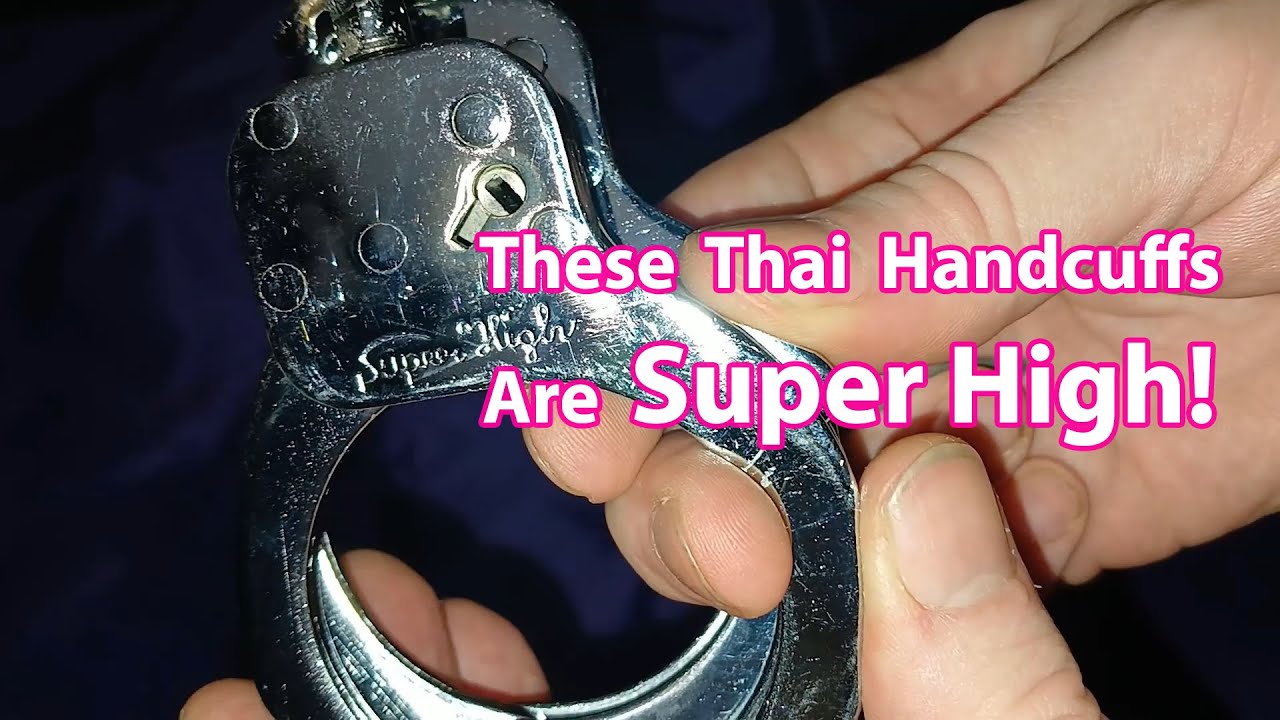
Thailand Super High single locking police handcuffs - Very shiny!
These are my first handcuffs from Thailand. They are marked Super High.
These are only single locking, they have no double lock at all. The mechanism is based on the Takeda / Masuri Japanese handcuffs, utilising a pin wheel mechanism with holes drilled into the thin edge of the bow.
These are all steel, likely plated with either nickel or chrome.
When I received them, the swivels were totally seized up. I had to use oil and pliers to work the oil in, to make them able to swivel. The swivels are not smooth but they do twist easily now!
The double lock on the Japanese Takeda etc models is almost pointless because of how easily both accidentally or intentionally, it is to disengage. So the fact that these Super High have no double lock, is a bit better than having one that is less useful than a chocolate fireguard lol.
Enjoy!
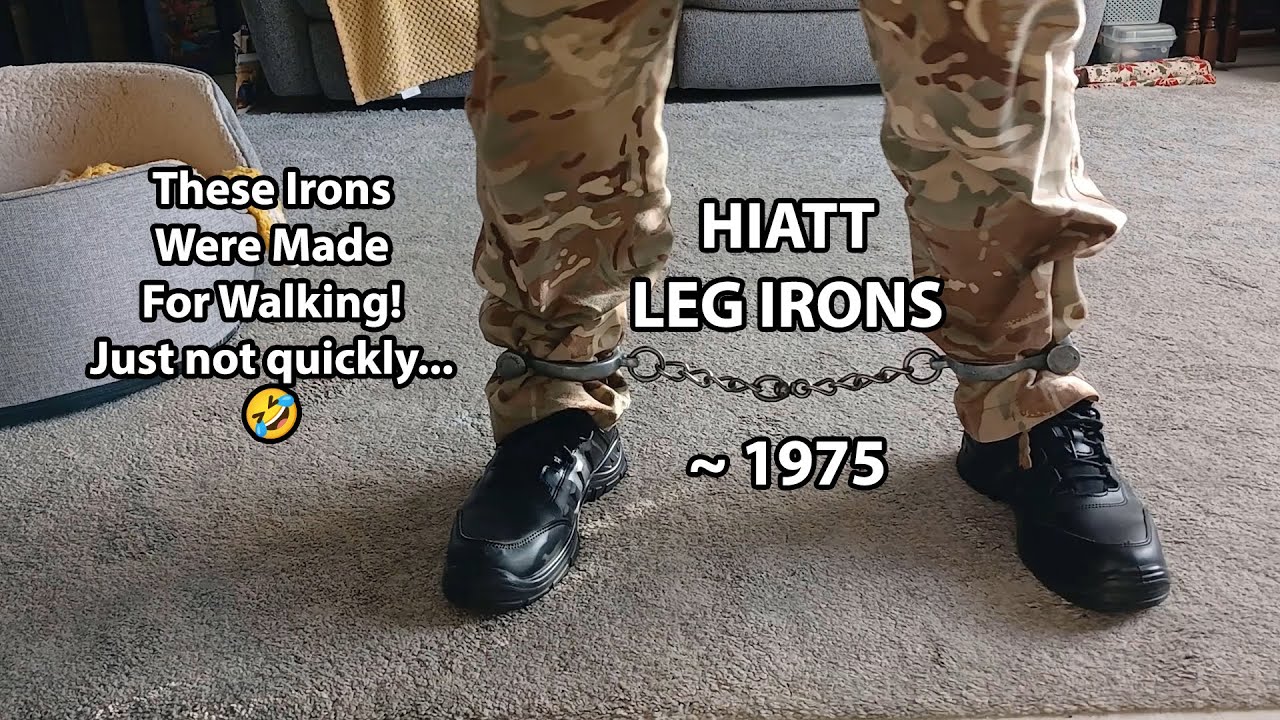
British HIATT Darby Leg Irons ~ 1975 Made from good quality alloy
These are HIATT Darby Leg Irons From 1974-1975 timeframe.
The chain and swivel are steel, but the body of the leg shackles are made from an alloy. Commonly referred to as "pot metal" although HIATT being a well known company of quality products, they used a particularly good alloy, perhaps Zamak 5 for strength. The construction is more bulky than the traditional all-steel versions and this is to accommodate for the alloy's properties to maintain the required levels of strength and security. Steel ones did not need to be bulked up.
They have the standard Darby locking mechanism, consisting of an internal sprung bolt which the key interacts with and on it's other end is the pawl that locks into the hole in the shackle to keep them securely closed. As you turn the key to undo them, eventually the collar on the key hits the resistance of the body of the shackle and from that point, the subsequent turns pull the bold outwards, freeing the shackle to open.
Because of the shape of the shackles, they are able to spin around quite well on the ankle, which aids in being able to walk in them better. They are actually quite comfortable.
These were made around 1974 to 1975. According to a reliable source in 1975 HIATT were just coming out with these Alloy models at that time. Being made of a quality "pot metal" alloy, they were cheaper and easier to manufacture. The rectangular and chunkier construction was almost certainly to counteract the shortcomings of the alloy to ensure they would meet security needs for real-world restraints while still reducing production costs and time.
Initially they were branded with the HIATT branding, but with rising tensions in the world about the use of leg irons and connections to slavery and degrading treatment of people, they stopped branding them.
Not too long afterwards of a year or two they stopped production. But the very latest ones they came out with prior to stopping seemed to have EVEN cheaper construction with rivets for the hinge pins and more sloppy tolerances as those were intended for markets other than genuine real security needs.
Given the history, the fact that mine are branded AND they have a number stamped on them and the key, coupled with the fact that the hinge pin is the classic steel type that is flush and the fact that the tolerances are nice and tight, these that I have are no doubt for actual real-world use, part of their initial line of Alloy leg irons.
Enjoy!
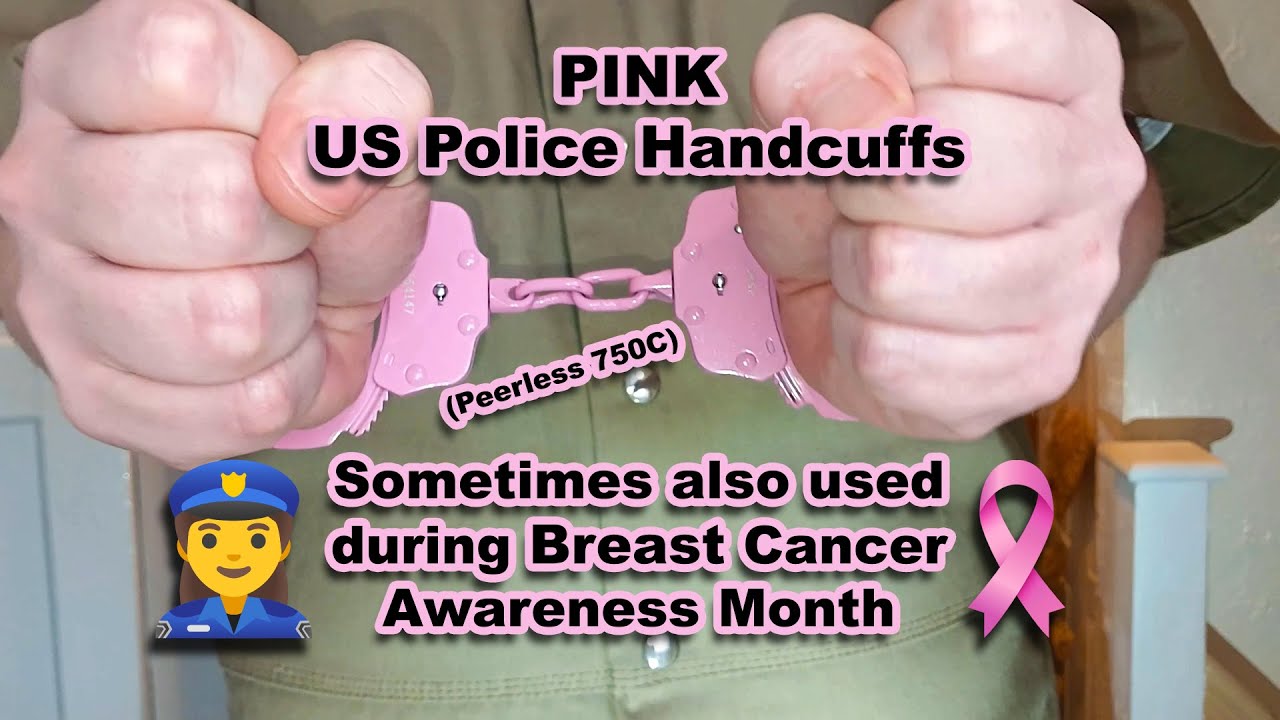
Peerless Pink 750C American Police Handcuffs Often used during Breast Cancer Awareness Month
These are the Peerless 750C or specifically 750CP handcuffs in Pink. Genuine USA all-American handcuffs that are used throughout the states as one of the top brands of NIJ certified law enforcement handcuffs.
These are a classic model 750C with pink colour finish. They have one pawl bar, peg and groove bow security, double locking, they backload (backloading is not that important and not a common feature).
Coloured handcuffs are often used in prisons and jails to coordinate with inmate uniforms or to classify someone with a health condition or a certain threat level etc. Also in some cases, non-masculine colour uniforms and handcuff colours have been used in prisons on overly aggressive prisoners as a punishment.
Another use for Pink, specifically, is during October which is Breast Cancer Awareness month. There was a US news story of Smith & Wesson and Peerless donating a bunch of pink handcuffs to a police department free and then the department let their officers BUY those handcuffs from the police department and then they gave that money they raised to the cancer charity.
Also some officers use different colour cuffs in the US as a way to personalise and get their own cuffs back so they don't get swapped around with other officers etc.
These Peerless model 750C are a high quality set of handcuffs. They can be found on Amazon. And in the US there's many places you might find them.
Enjoy!
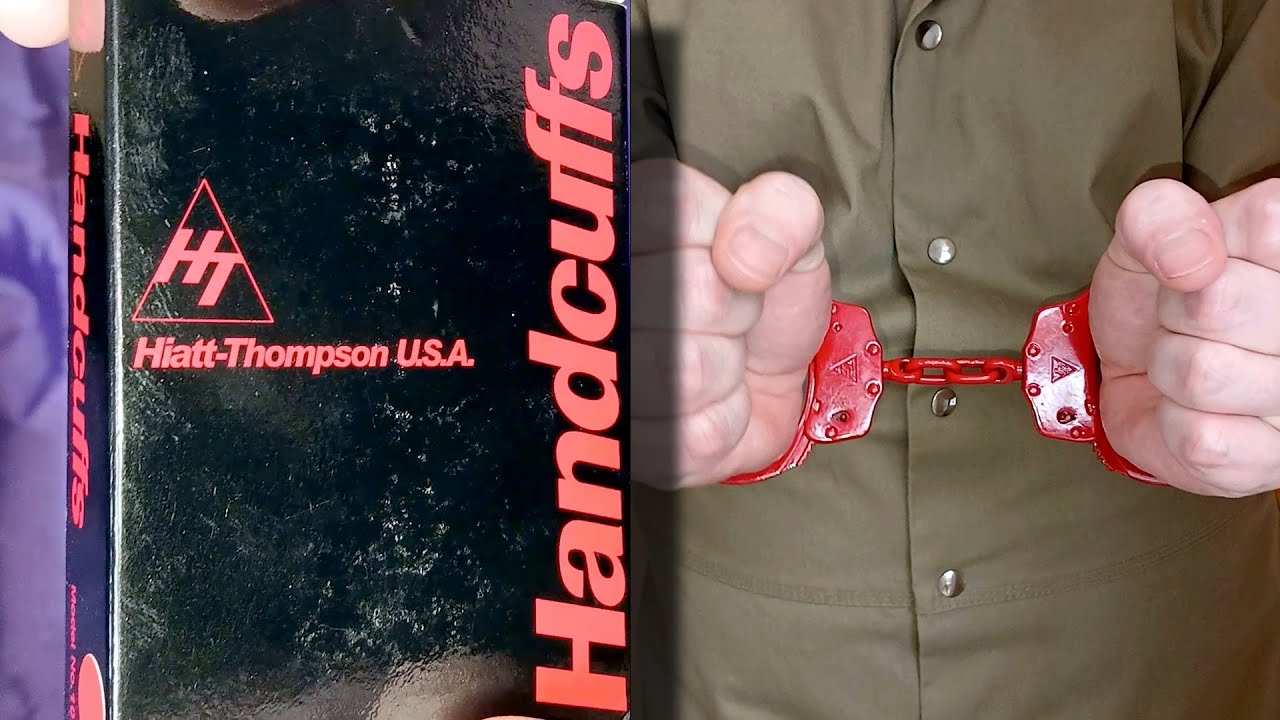
Hiatt-Thompson 1010 Chain link Red Police Handcuffs
These are the Hiatt-Thompson 1010 chain link handcuffs in the colour RED. They are genuine US police handcuffs.
This company is no longer around but I have a feeling there is a connection to CTS Thompson because even the model number is the same as the CTS Thompson models. (Don't visit the website on the box. After the company was no more, they didn't renew the domain to keep control over it and so it has been acquired by people in China and is riddled with adverts and NSFW material)
These have 2 pawls and they also backload, which is nice. They also have a split double locking bar, which means if you are picking these open, you must pick both levers to disengage the double lock. It sounds like you unlocked it, it feels like you unlocked it, but they are still double locked until you pick the second lever! The ratchet is strong and loud.
Nice to add one of this brand to my collection, though it is a very typical handcuff but with twin double locking bars, and in a nice red colour.
Enjoy!
Smith & Wesson M100-1 WeatherShield (Blue) Handcuffs Overview (NIJ)
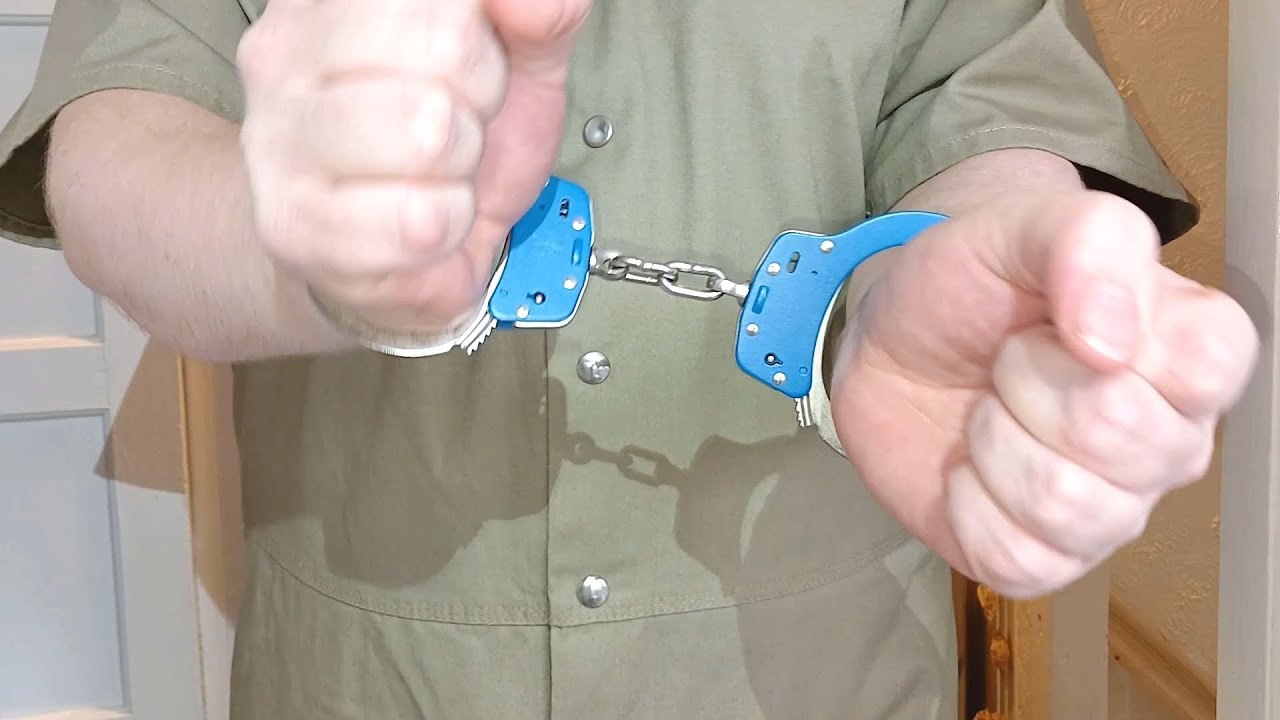
These are my new Smith & Wesson Model 100-1 WeatherShield handcuffs which come in Blue color. I sold my yellow ones years ago and regretted it ever since!
Very smooth, very high quality and internationally known handcuff that is NIJ certified for law enforcement use. But these particular ones are more resistant to water, supposedly, which is why they call these WeatherShield. They are powder-coated blue for extra durability and identification.
Comfortable both to apply to someone or the person with them on.
You can lubricate them with a light oil now and then to keep them nice and maintained (or use Dry PTFE spray as I do). Like usual, I waxed these with renaissance wax for extra smoothness and protection.
The WeatherShield or Weather Shield line did not last that long. I'm not completely clear why, I have seen some info suggesting they changed the methodology of their colouring, not sure. The yellow was wearing a bit on my old pair. But they are very very uncommon in the UK. I got my yellow pair years ago from some random US-based Amazon seller and never saw them since, until recently on eBay many years later! So I had to grab them immediately!!
I demonstrate them with my on-person demo while wearing some bright and plain Khaki US prison clothing so that the cuffs show up better. Normally I wear a lot of black or camo trousers and black shirt so cuffs don't show up that well. So having a plain and brighter background helps. Plus contextually it is more applicable.
Enjoy!
Polish Kel-met KM 1100 Single-locking Training Handcuffs
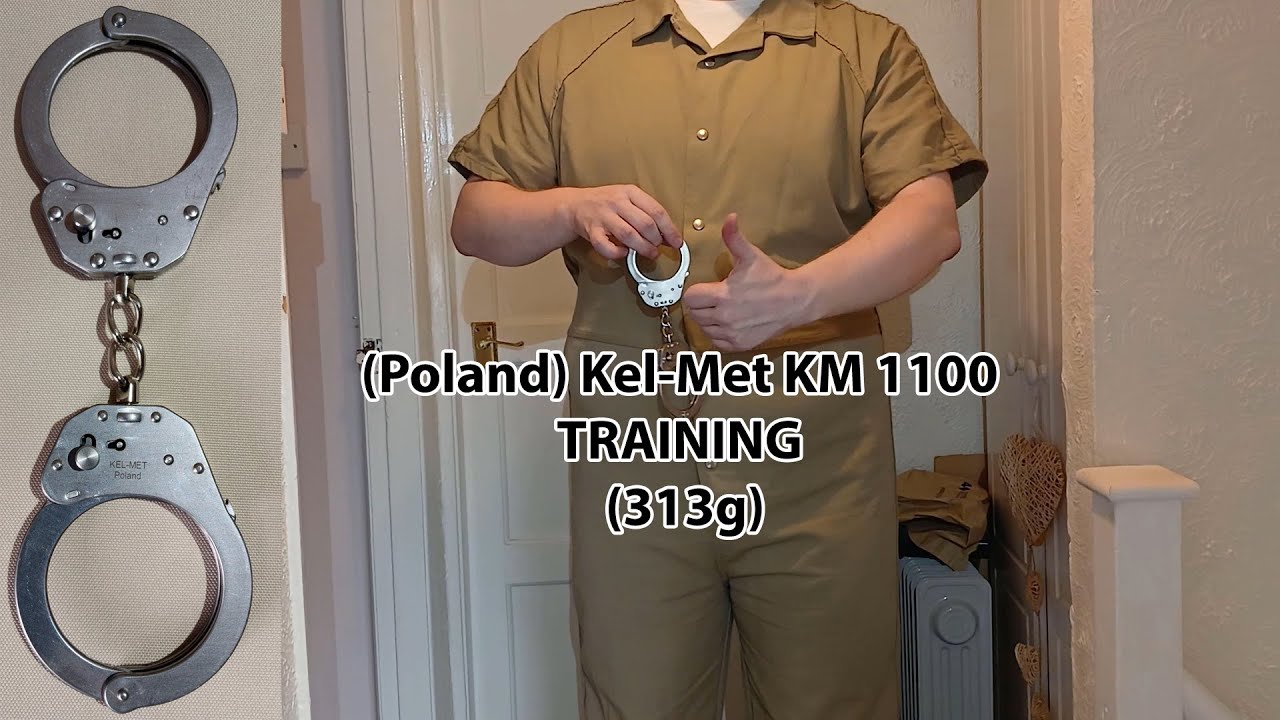
These are the Polish Kel-Met KM1100 training handcuffs. They are designed to aid in training officers/security/military on the application of handcuffs, with added safety in the training environment and with the increased speed of not having to deal with keys and double locks.
The fact that they have no double lock, makes this obvious to me that they are not for a complete training of complete standard operating procedure, despite how important double locking the cuffs is. This is clearly just about training people to apply the handcuffs onto the person successfully and then they will follow SOP after it's importance has been drilled into them over and over.
They are stainless steel (more skin-safe than typical plated handcuffs) and use only 1 pawl, since there's no need for multiple pawls for a training handcuff.
It's a nice handcuff and the slider buttons are fairly easy to operate on your own, for safety reasons.
One thing to be aware of is the slider buttons are actually screws. On my pair, one side was very loose and the other was super tight and I was unable to unscrew it even with pliers. But the other side was always loose so I just applied some blue Threadlocker and tightened with pliers and now it feels very secure from accidental unscrewing by hand contact. I would have used red permanent threadlocker but I have none. If buy buy a pair, ensure you check them to make sure they are tight!
I can imagine some people might use these within a bedroom context because of how real they feel (they are real cuffs...) but the fact that they have a super fast way to open them if need-be.
Enjoy!
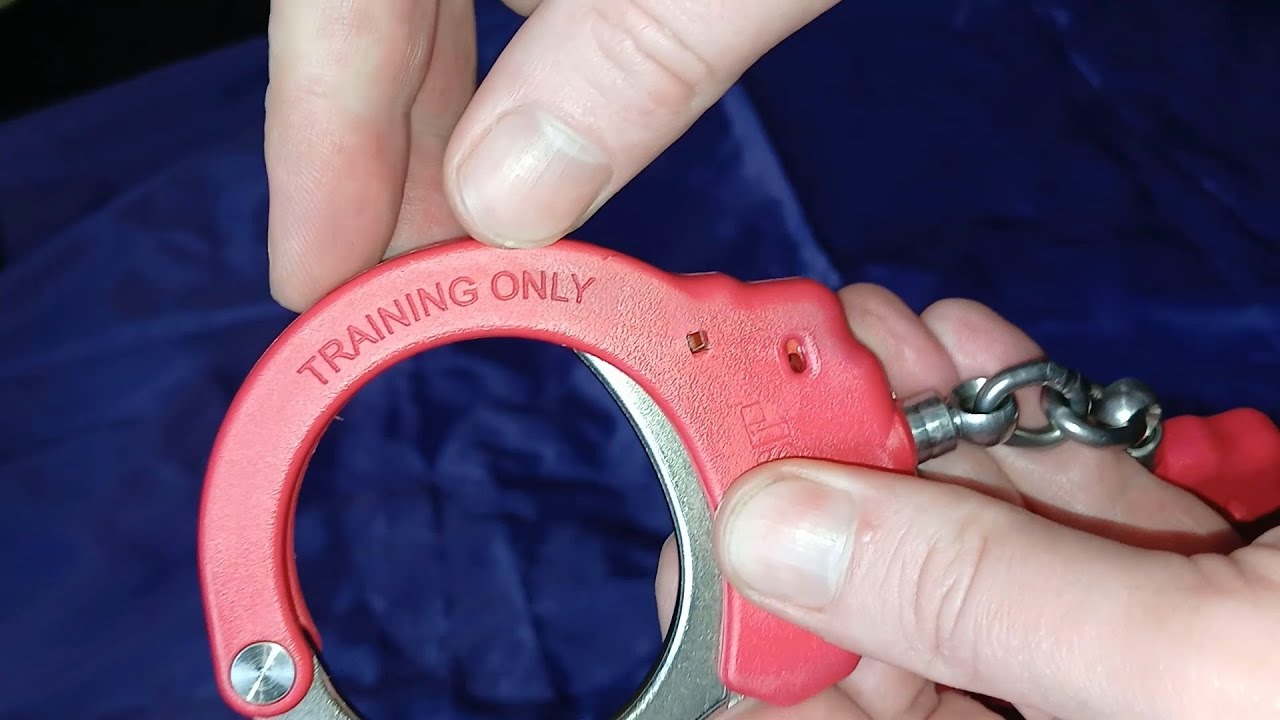
ASP model 100 Red Training Handcuffs with Slip Pawls (factory gimmicked)
However I found it odd that they would leave the double lock functionality intact...!?! Whenever I, myself, gimmick a handcuff, I always do my best to deactivate the double lock to ensure only the single lock functions. When people training to apply handcuffs, they have to learn to use the double lock and when they do during training, the wearer cannot pull the cuffs off. So... not sure why they wouldn't just simulate the double lock feature but just not have it actually double lock. But that's just me.
What I have done since recording, is take some JB Weld Steel Stik epoxy putty to make tiny "door stops" for the hidden section of the double lock. So once I re-insert the lock-sets, the double lock won't engage because the space it needs to move outwards into, has some shaped hard epoxy putty I can slip in or remove if I want to make the double lock work again. So now there is zero chance of them double locking. This is good if you want to put the training locks in a normal set of ASP for single lock picking or as a costume prop, because if anyone puts them on, nobody can troll the wearer by double locking them to get them "stuck". If you would like me to make a video demonstrating this double lock deactivation "door stop" let me know.
These are in pretty good condition, no obvious cracking in the polymer. They are basically a yellow security cuff but with the only difference that the pawl's teeth are angled on both sides to allow the bow to pull open rather than only push closed.
Enjoy!
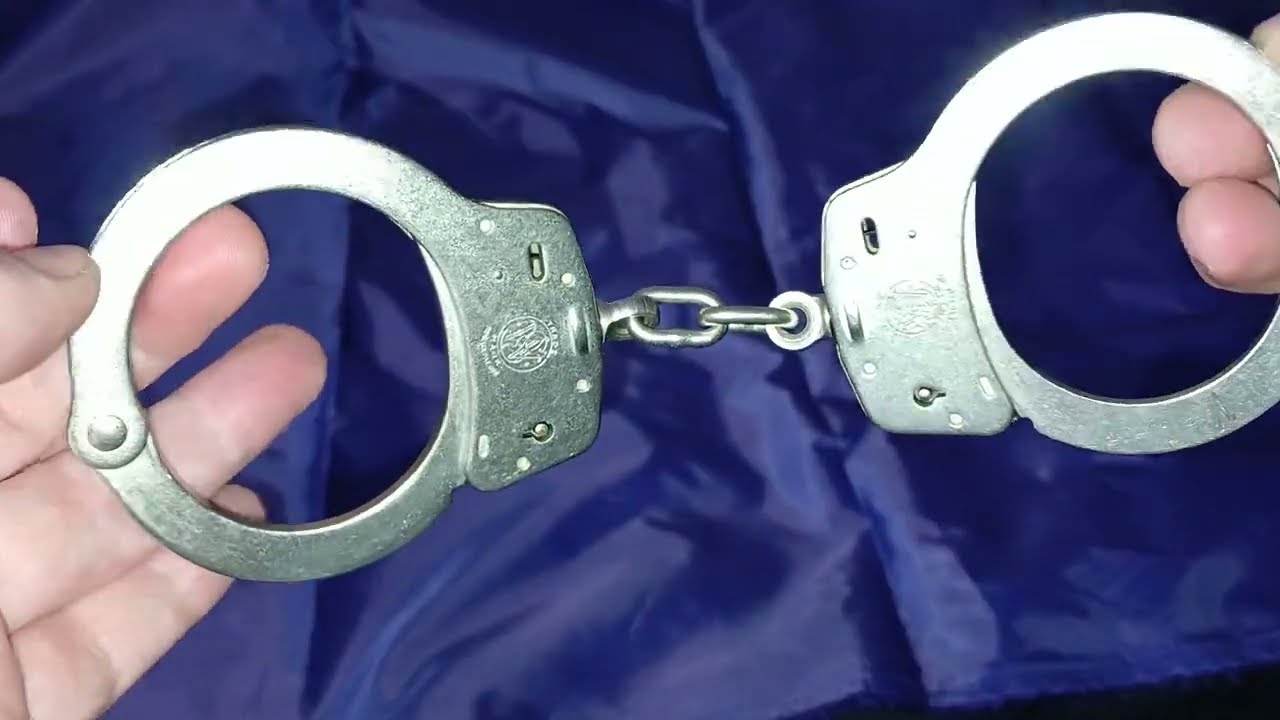
An Early Smith & Wesson M100 (not 100-1) 1980 Police Handcuffs with PATS PENDING stamp!!!
These are the American Smith & Wesson model M100 handcuffs that came out about 1979. The patent wasn't granted until 1981, so the fact that these have PAT'S PENDING on means they are an early model, which is very cool to own!
These were the first time they had their new design of double lock whereby the internal spring also was the double-lock itself. These are stamped with their old Springfield location and soon after this they moved to Houlton.
Basically these are basically identical in function as the modern M100-1. The only real difference is the way the handcuffs are manufactured. Modern ones use rivets to hold everything together, whereas these old M100 have indents around the edge to help line the pieces up correctly and then heat, coupled with a special material added during construction sort of welds everything together. Apparently this older method was more secure of holding the handcuffs together. The modern rivet method is cheaper but still effective.
There was an revision of this M100 whereby the double locking window was not all the way through the cuff, but only was open on the front-facing cheek plate. But they quickly altered the design by having the hole go right through for easy double-locking from either side.
When I received them, the bow on one side was bent a bit and would not freely swing-through without being forced and the double strand was slightly bowed outwards. But I rectified this with a vise and a few bashes and bends by hand which gave these cuffs the chiropractic adjustment needed to function normally and healthily!! 😜
They seemed a bit hazy on the surface so I gave them a light once-over with some 0000 steel wool with some Autosol mixed into it and then after wiping the residue off I wax polished them, as is typical for me, with Renaissance wax. Of course I used some PMA Brake and clutch cleaner to blast out the internals before re-lubricating and cleaning them.
Lovely handcuffs! I wanted an M100 for years but when I found these and the fact they have PATS PENDING on them, since I found nothing else to buy I had to get these before anyone else. About the only place I see these being used any more are on TV and movies, because the prop departments would have gimmicked them many years ago and never needed to throw them out with the little use they get.
Enjoy!
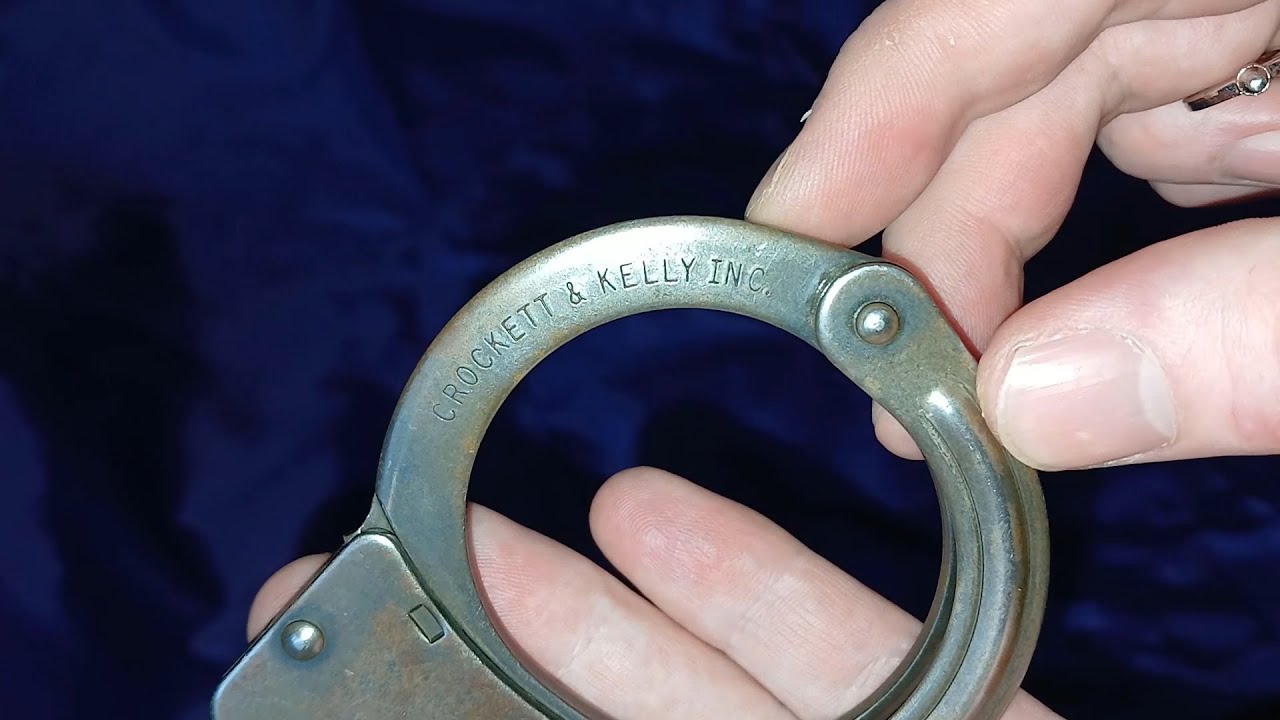
Crockett and Kelly Model 1 (Version 2) American DoD Military Police Handcuffs Mid 1980s
These are the Version 2 of the model 1 Crockett and Kelly handcuffs. It seems the US DoD (Department of Defence) placed an order for them because they were a lower cost handcuff. So these would have been destined for military police, most likely.
They are a spitting image of American Handcuff Co handcuffs, but with double strand designs that are similar to the South Korean company Kyung Chang. The bulge in the double strands gives them a unique look.
These have 1 pawl (as you would expect with most US handcuffs) and they double lock. There is no backloading feature for the single strand.
The build quality is quite decent, except that there is a bit of a gap between one of the cheek plate sides and the body of the handcuffs, reminiscent of how Russian handcuffs are very often. Like it was not quite riveted together as tightly as it should have been.
The branding looks nice on the single strand / bow.
I like them! Another American handcuff in my collection.
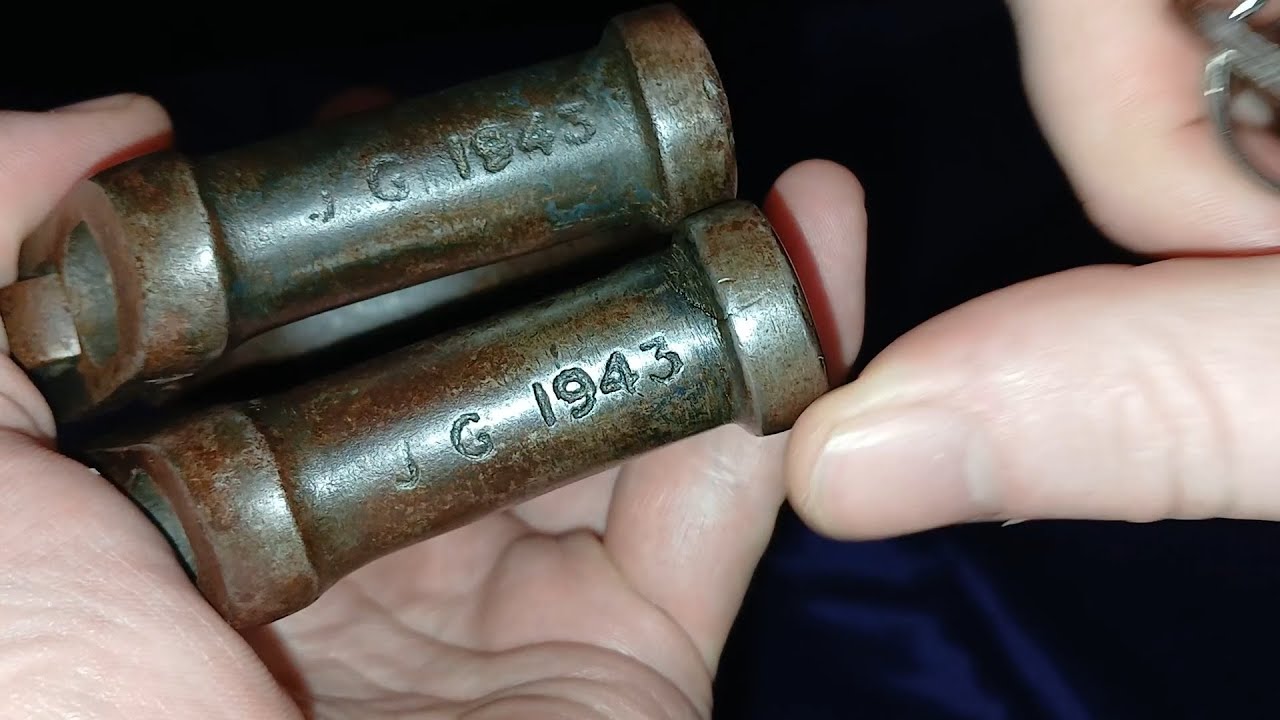
JG 1943 WW2 False Backstrap British Military Darby Handcuffs
These are JG (J.G) Handcuffs from World war 2 ( 1943 ). They are British Army issue and have the Broad Arrow (or crowsfoot as it's sometimes called) stamp very clearly on the lock tube.
These are really cool and heavy handcuffs (605 grams), though strangely are a bit on the small side. I can just about fit my wrists in them but they are certainly not comfortable at all, so I won't be doing an on-body demonstration.
These are a false backstrap, which means the hinge looks like a backstrap but it isn't. Imagine a backpack strap. You have the material end and the other end is a buckle kind of thing. The shackle of the cuff is longer and gets fed through a rectangular hole made in the lock tube and then the shackle tail bit is folded back on itself so that it is permanently linked to the lock tube.A FALSE-backstrap like on this handcuff is opposite. The lock tube does not have a solid rectangular hole made, it has pincers that are poking outwards and the shackle is meaty on the hinge side and has a hole drilled through it. The shackle is placed between the pincers that are part of the lock tube and then the pincers are crimped inwards into the hole that is on the shackle to create a permanent connection and form the hinge.
There is a little crack near the cap end of the lock tune on one of the cuffs that lets light shine through. Though there is more than enough integrity surrounding it so that it's not a security issue or any form of show-stopper. 00:43 shows the crack on the bottom shackle near the right side by the plug end.
All in all, very nice indeed! Very happy to have another world war 2 handcuff in my collection and a British Military one at that! The little nick on the key barrel and the crack in the lock tube leads me to believe these have likely seen some serious action.
Anyway, Enjoy!
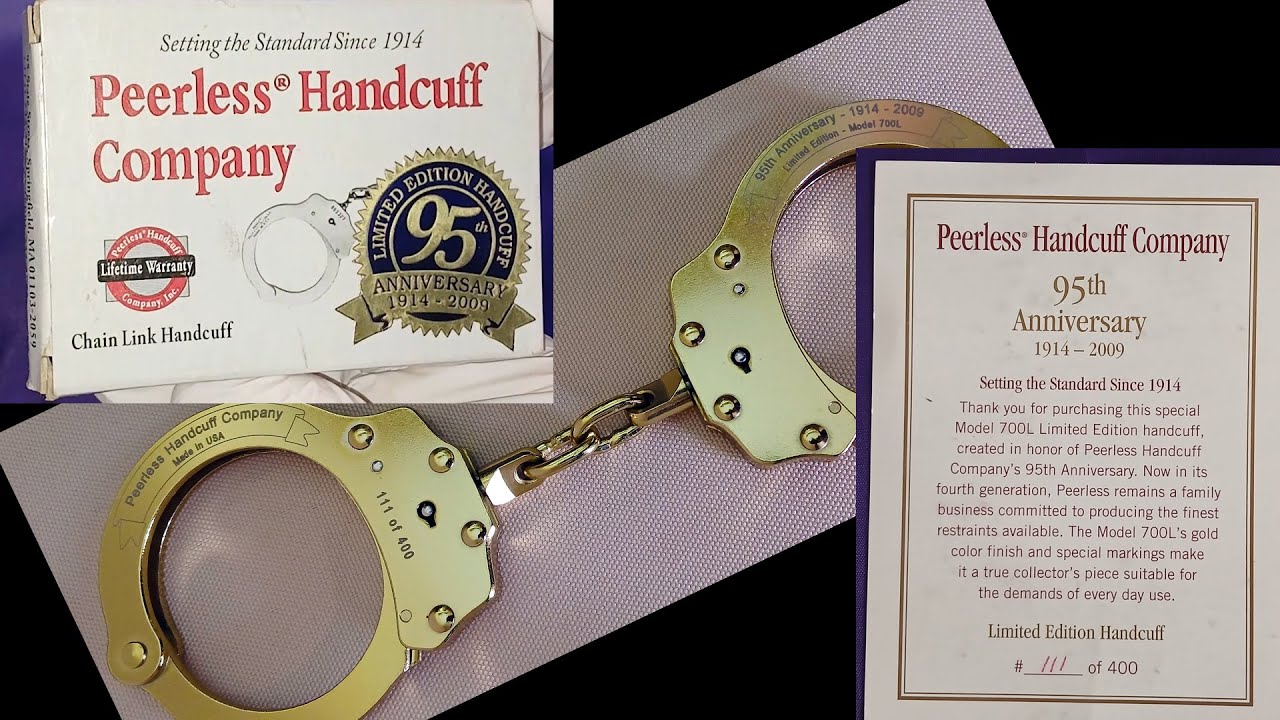
Limited Edition Peerless 95th Anniversary Gold Handcuffs! Model 700L only 400 were made in 2009!
Many thanks to the Doncaster Restraint Museum DRM for helping me acquire these. These are the, now, hard to find Peerless 95th Anniversary golden handcuffs. They were made to commemorate their pride in having made great quality handcuffs from 1914 to 2009 at that point. Well done Peerless!
I wore white nitrile gloves for this video because I did not want to get finger smears on them on the video lol!
These handcuffs are not a genuine gold plate, but they are a nicely golden coloured type of nickel finish. I have been informed that the golden finish on these 95th anniversary cuffs is more hard wearing and long lasting compared to a 24 carat gold plated handcuff.
I have serial number 111 of 400 which is a cool number, I think! These all sold out years and years ago, since they were only manufactured in 2009 and only 400 pairs were made. So the only way to get a pair is to find a collector somewhere who is willing to part with them.
It is a typical Peerless model 700 handcuff (700L), with all the same design and features, just with the lovely shiny gold colour to them. I have not done an on-person demo of them because it was too difficult to try and get the gold to come out right on the video when I tried. But in person to the naked eye they look really nice indeed!
Enjoy, like and subscribe! 😁👍🏻
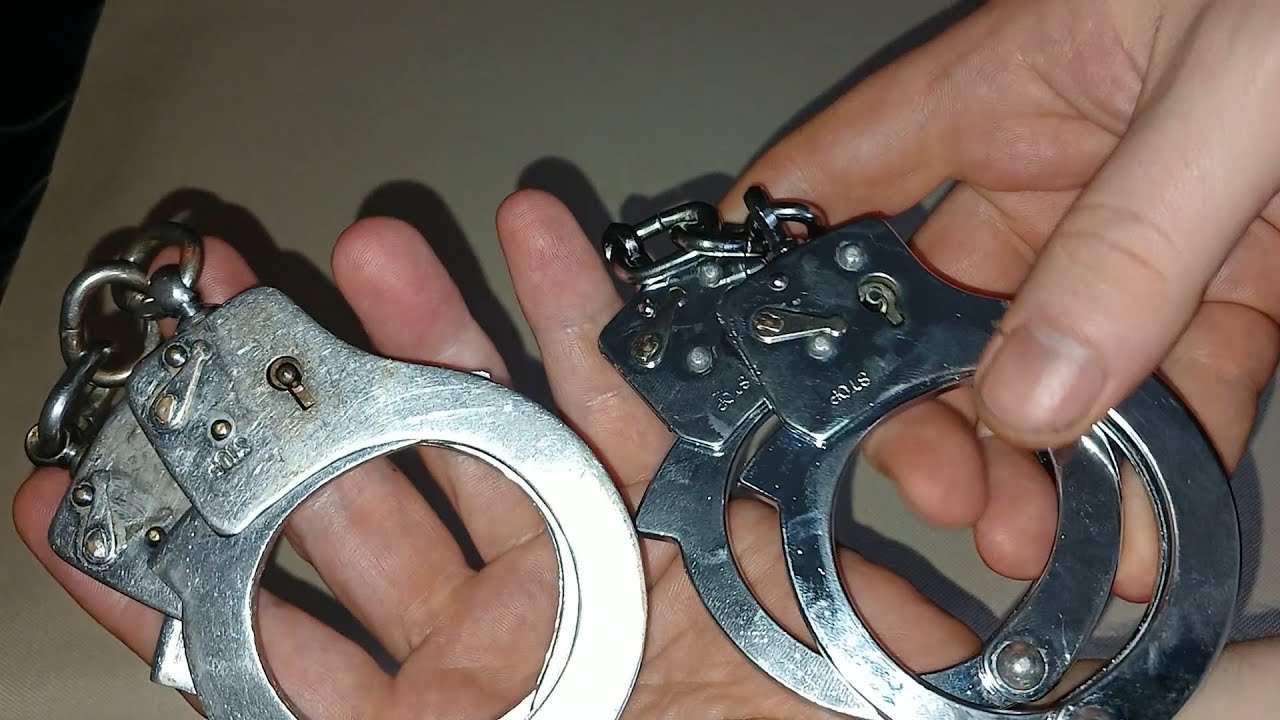
Japanese Takeda Police Handcuffs - Comparing the REAL police ones to modern toy copy versions
These are Japanese Takeda police handcuffs likely from the 1970s. The design is familiar to many, as a toy handcuff. This design was a genuine police handcuff, long before it was copied by toy manufacturers. There were solid brass ones and steel ones with brass bows. This is the latter.
The design of these handcuffs is very basic and to be honest not that great. It has a nice pin-wheel design that cannot be shimmed, but the double lock is merely a switch which easily and trivially can be switched one way to double lock and the other way to undo the double lock, making them not very safe from police liability.
These have welded chains, no rivets on the back and only 2 rivets or protrusions on the front to prevent the double lock switch going too far.
This design of handcuff is best known as being toy handcuffs and are sold all over the world, using lesser quality parts and lacking security considerations. For example the toy versions are made of more flimsy metal, they have exposed rivets to try and keep the things together and their chains are not welded, which means a strong person could pull or twist on the chains to get out of them. Also often the swivels on the modern toy versions are longer, which makes them more likely to snap.
This pair of actual Takeda handcuffs was used by someone in the Rhodesian BSAP police force. However it is a Japanese handcuff and even has JAPAN stamped on it near the swivels (not sure if I got this on video).
I thought this would be a somewhat interesting video to show you a pair of "toy" handcuffs that are actually not toys and were officially used by police forces and compare them to actual modern day toy versions.
Enjoy!
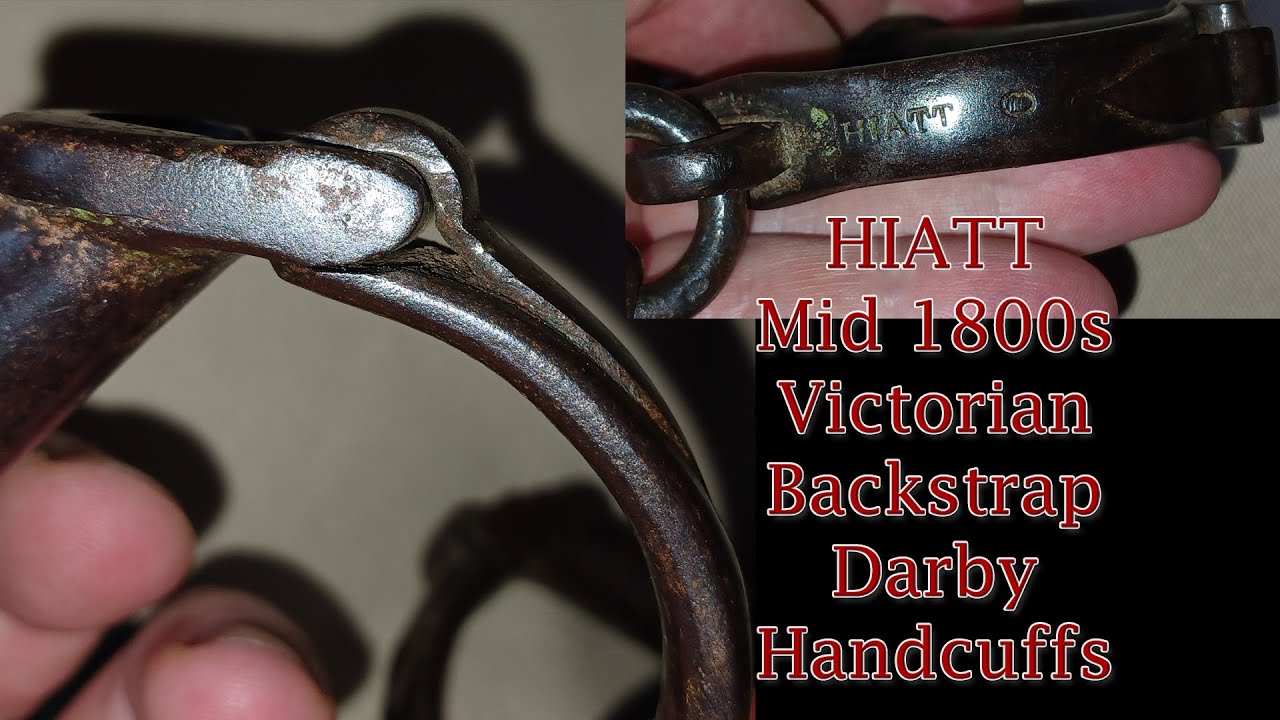
HIATT 104 Approx mid 1800s Genuine Backstrap Darby Victorian Police Handcuffs in GREAT condition
Happy Handcuffs day! (Feb 20th) These are a Victorian pair of HIATT 104 Darby Backstrap handcuffs from the mid - late 1800s.
These differ from my other HIATT 104 handcuffs, in that these are a genuine backstrap or back strap. This means, instead of having a more modern hinge style where the two sections mate and a pin is pushed in to keep them connected, these instead have an elongated tongue at the end of the shackle which is fed through a specially made gap in the lock tube and folded back on itself to create a sturdy hinge. It is quite an elegant system, really.
In the early 1800s, Darby handcuffs had various hinge styles, including backstrap and pinned hinge. There are also later hinges called False backstraps, like on my JG Army handcuffs which was a somewhat similar visual style but instead of folding a tongue over to create the hinge, the shackle was made more chunky and a hole drilled through it, at which point the lock tube would be permanently connected through the hole in the shackle.
I am incredibly happy to have an actual backstrap handcuff in my collection! They had been in the original owner's family for many many years. Handed down. The seller's Granddad had them since before WW2 and I would imagine his dad gave them to him since these are from the 1800s, given this old hinge design. I got a great deal on them. I could not fully tell from the images but once I got them, I knew for sure what I had! They had some surface rust but were in amazing working order. I used a bit of super fine wire wool, some peek metal cleaner, Autosol polish and Renaissance wax polish and now they look a million miles better.
They are less heavy than my other 1800s pair of HIATT, by about 100 grams lighter (these are 397g, whereas my more bulky 1800s pair weigh 496g. They are what I would call a large size. I have somewhat large wrists and there's decent room left when wearing them.
Best estimates I have seen from people with more experience of varying models, are that mine are an early Hiatt backstrap pair from approx 1850 ish (mid 19th century) So at the time of making this video, they are probably 160 years old and still work smoothly!
Enjoy!
ASP S100 Sentry Chain Police Handcuffs In All Stainless Steel ~ ASP Features at Lower Cost
These are the ASP Sentry model S100 chain-linked handcuffs. These are the first in a lower cost or budget line of restraints that provide some nice ASP safety and quality of life features, at a lower price point. VERY worth the purchase for LEO officers and security etc. They weigh 348 grams, which is more heavy than the 288 grams statistical average weight of handcuffs of this style in my collection. But they are robust and have features that are worth it, in my opinion...
With ASP you get smooth edges, double locking via the slot window and via the keyholes, keyholes on both sides and these Sentry handcuffs also have these features.
You get very smooth action which is almost guaranteed every time to engage the bow when applying the handcuffs, even when not much force is applied, making manual tightening easier.
They have a single pawl, like the yellow double lock window models of their higher end and previous models. Another plus about modern ASP handcuffs (I think the more expensive Ultracuffs have this too) is these chain cuffs are more resistant to chain-binding attacks. Chain binding attacks are where someone in handcuffs can literally snap the handcuffs and escape by binding the chain on its self and applying force with their arms and snap them. These Sentry (and as I said, I think the others too) have a special system which reduces (or maybe prevents) this from happening... Something to consider.
There is a downside to Sentry models, which is almost a non-issue due to their construction! With Sentry models, you cannot replace the locking mechanisms or "lock-sets" as they call them. However... These Sentry are all steel, like any other police / regulation pair of handcuffs, whereas every other ASP metal handcuff, including the high end Ultracuffs have plastic internal parts which can break. So it makes total sense for the ultracuffs to have the facility for owners to buy and replace their lock-sets at will, to reduce costs and prolong the life of their handcuffs. Since these are all steel, there is no plastic to wear out or get damaged any faster than any other totally metal handcuff like Smith & Wesson or Peerless.
So, why bother with Sentry if you have a profession where you already have handcuffs? Lower chance of injuring someone, easier size adjustment since you can re-double-lock the cuffs via the keyway instead of having to remove the key and re-locate the DL slot window and these cuffs engage quicker and easier than almost any other brand. The only brands I know that can rival the smoothness on these are Alfa-Proj (which have the flat keys) and Kel-Met.
These are very worthy to be purchased by any and all LEO police or security personnel who want a really good quality handcuff, with additional safety and convenience features at a more affordable price.
These will fit in more cases than the more expensive Ultracuffs from ASP since they are a tad thinner.
Designed by ASP in America, these are manufactured in Taiwan, but by a company who does a FANTASTIC job of manufacturing handcuffs, clearly. These are not cheap rubbish, these are the real deal.
Enjoy!
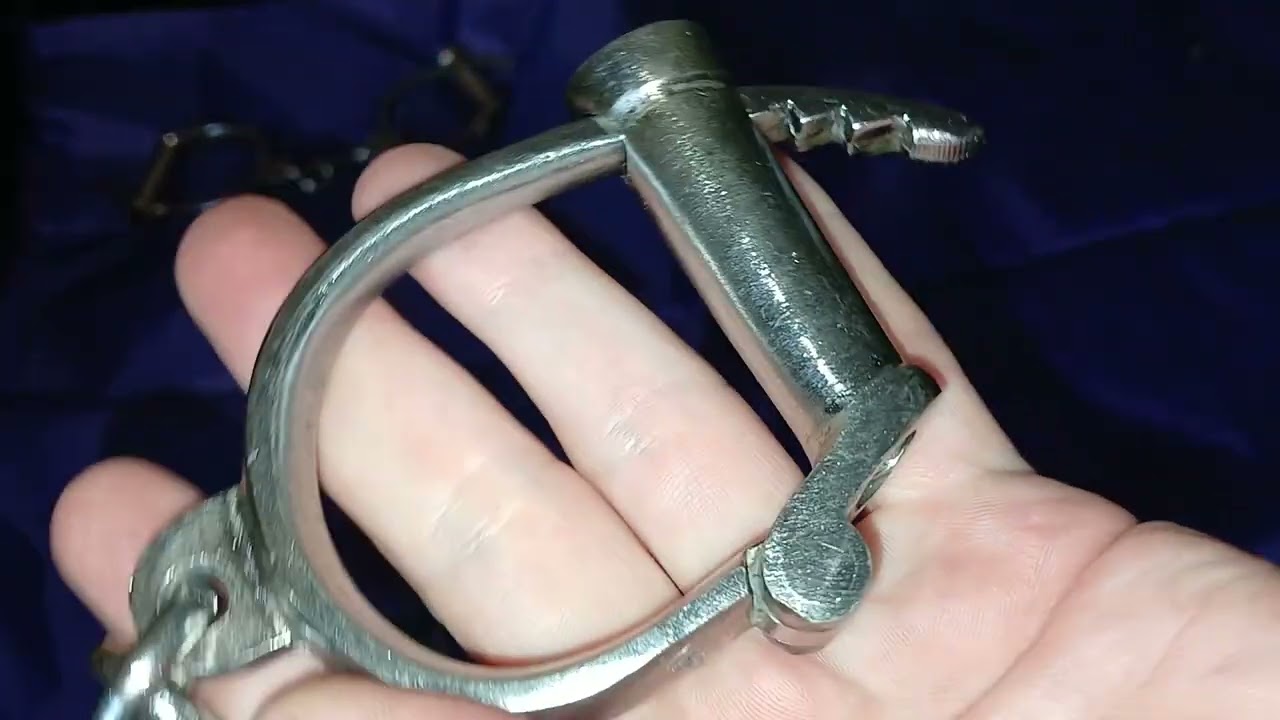
HIATT 115 Scotland Yard Adjustable Darby Handcuffs - A Later Alloy Version?!
These are the Hiatt 115 "Scotland Yard" adjustable darby handcuffs. My existing pair is gimmicked, meaning they pull open. So now I have a non-modified original pair to put in my collection so that I can pull my gimmicked ones out and keep them separate with the rest of my gimmicked cuffs.
I have not done an on-person demo of these because the springs are very strong and hard to operate with one hand.
They are basically a darby style handcuff which has a ratchet so that they can close smaller and smaller to fit the wrist size of the wearer. It was a great idea, but since the mechanism has to be exposed by the open hole at the bottom, it is possible to stick thin objects in and release the handcuffs without having to use the key. They were not super popular from what I have heard. Standard Darby non-adjustables were preferred for a very long time.
This pair is from perhaps the 1970s or 1980s, as they are not steel. They aren't the grey ones which were more cheaply constructed, but a better version. Non-magnetic essentially (very very slight attraction, maybe from the plating). Almost as heavy as my all-steel ones.
I was hoping to get a pair from the early 1900s to go into my British Police Cuff Lineage box, but these are legit and will serve the purpose of filling a gap in my collection.
I'm glad to have a non-gimmicked pair in my collection!
Enjoy
Subscribe to:
Posts (Atom)