Showing posts with label silver. Show all posts

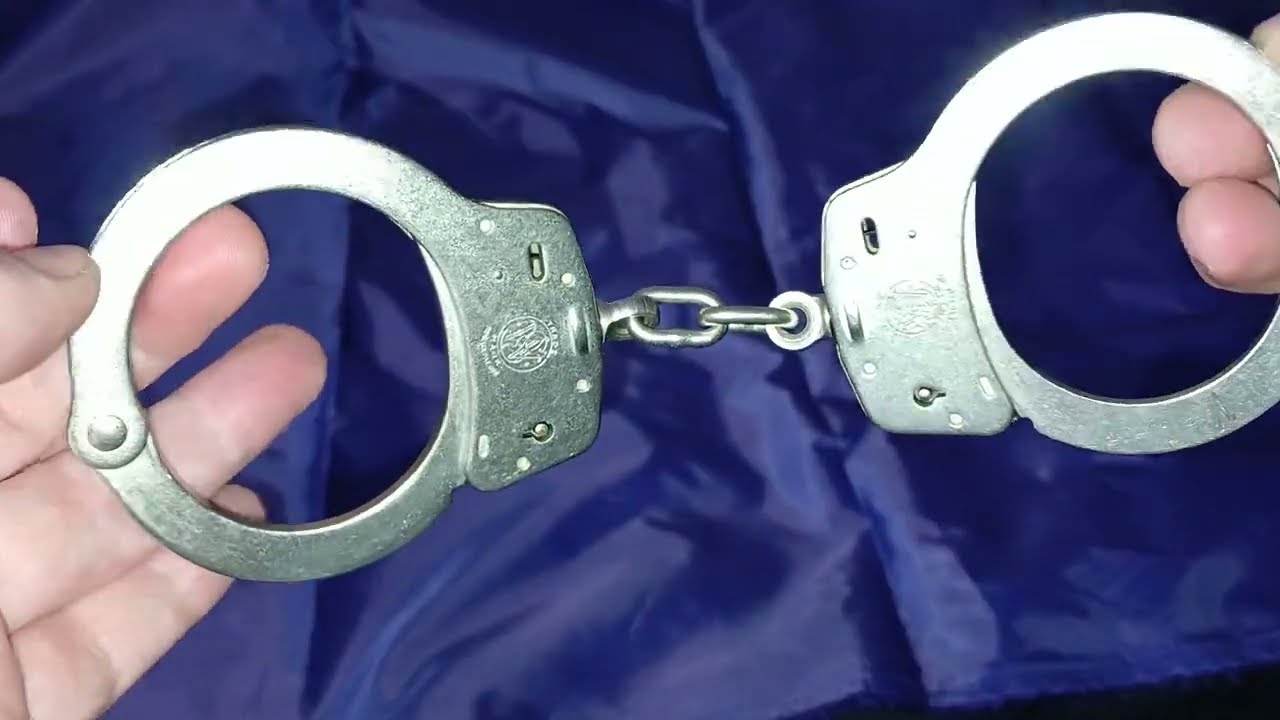
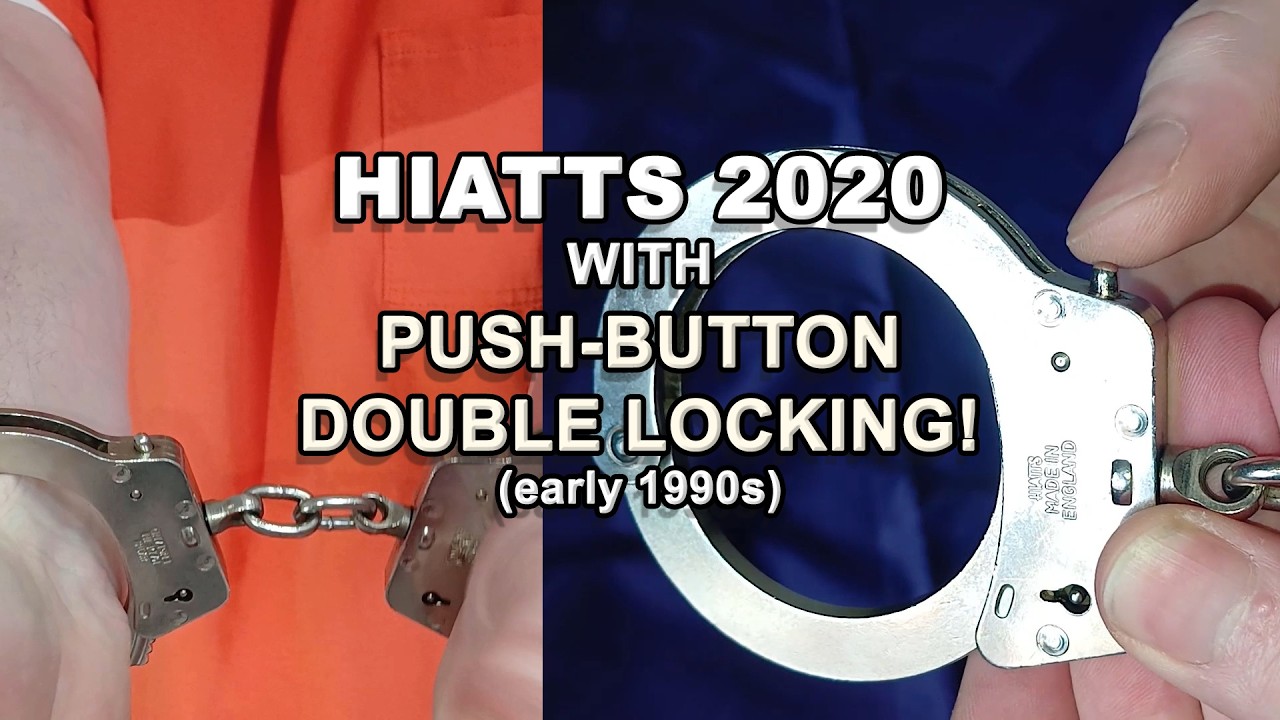
Quite Scarce HIATTS Model 2020 British Chain Handcuffs With External Push Button Double Locks!


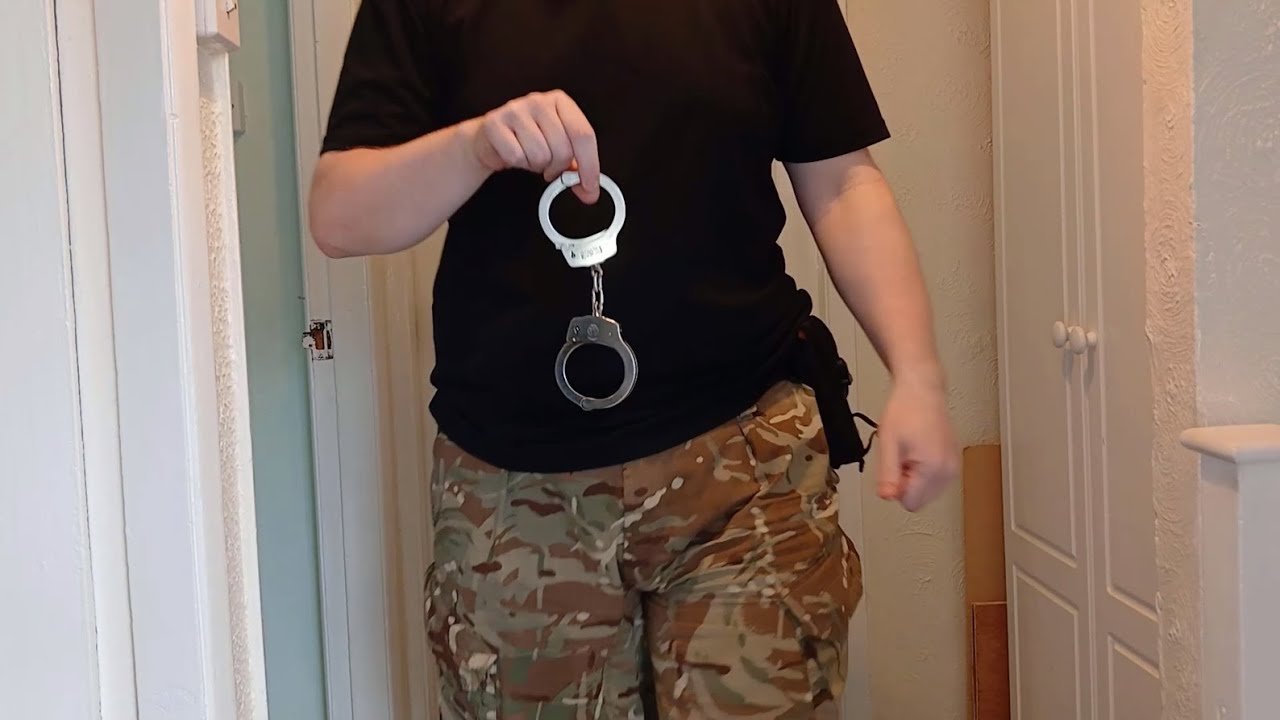
These are the HIATTS 2020 chain-link handcuffs with external push buttons for the double lock. They are very, very early 1990s, given that it is a classic HIATTS 2010 design with leftover swivels from the prior 1980 model.

It was a bold experiment, to increase the ability to double lock the cuffs in a hurry without having to use the back end of the key. But it had an unforeseen detrimental effect. The handcuffs could accidentally double lock while in the case on the officers belt or even while gripping the handcuffs to apply them. This means you pull the handcuffs out to secure a criminal... and they won't go around the wrist. Or as you are applying them, you get a couple of clicks or so around their wrist and your grip presses the double lock and they won't properly tighten. Very inconvenient when struggling with a criminal and you have to unexpectedly dig your key out, undo the double lock and re-single lock the cuffs without doing the same mistake again!

These are not a very common item, because they weren't deployed widely, after these issues were noted. Usually cost more than a regular surplus pair of HIATTS 2010, at least 2 or 3 times the cost. I got mine for less than half price of what I would pay for a 2010!

Also, this is the first appearance of my genuine US prison Bob Barker brand orange 2-piece prison scrubs in a video. Plain prison clothing like this in Khaki or orange, provide a nice plain background that is bright enough, with no distracting patterns or dark colours that reduce restraint visibility. This way, you can more easily see the handcuffs or leg irons that are being shown in a worn context, compared to back in the day when I wore my usual black clothing. After all, the items are the only star of my videos! Plus the clothing is a good match for the context of the usage of restraints.

Please like and subscribe.

Enjoy!

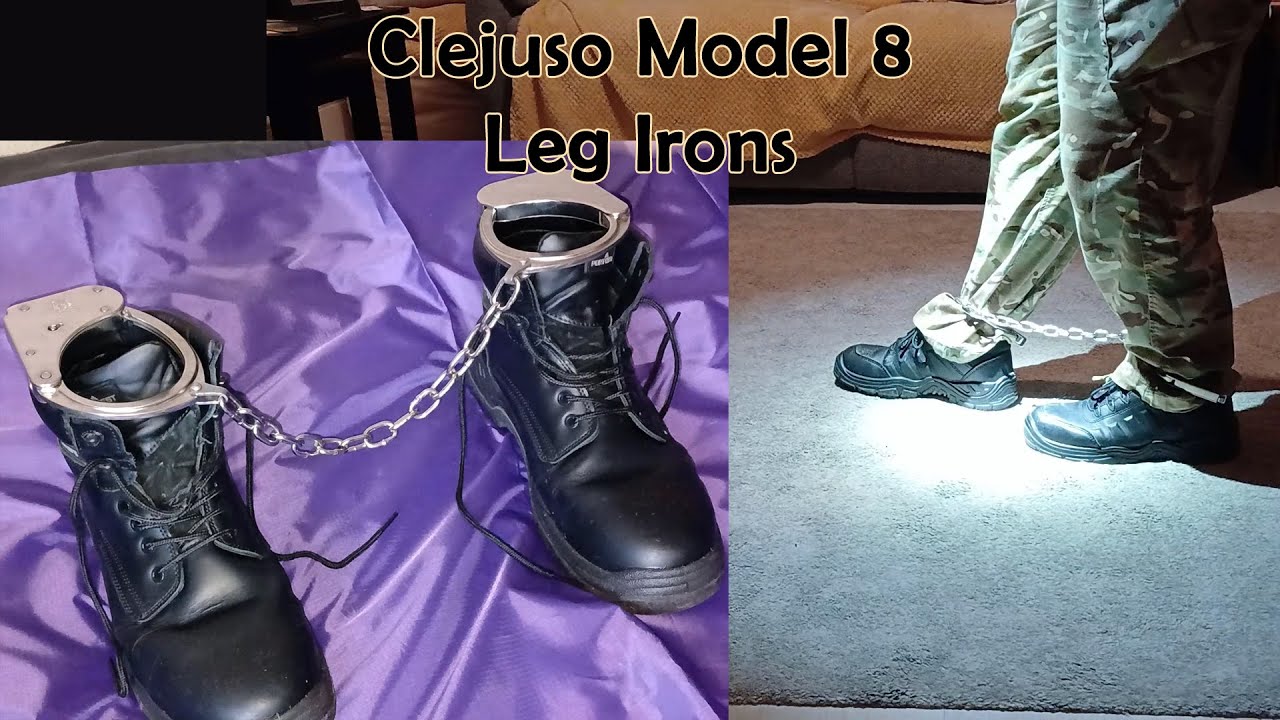
Clejuso model 8 leg irons from Germany


These are German leg irons from Clejuso, model 8.

These are made from Zamak material rather than steel, similarly to their model 13 and 15 beefy handcuffs. It's a strong zinc alloy, but requires more bulk of the material to off-set it's lack of inherent strength that steel would have. This produces a strong restraint that is not as heavy as a solid steel one would be.

They have a steel chain and the internal mechanism, except the spring, are also Zamak alloy. The springs are presumably steel.

They are not swing-through, but they have a double lock, as you would expect for safety and security reasons. It's basically like a HIATT 115 Scotland Yard handcuff, made larger for legs, with a double lock added.

The chain is short (just slightly less than 30cm long, which means your walking stride has to be significantly shorter than normal a normal walking pace. Also, the design of them is not super comfortable and if you try to walk faster, the rotating of the shackles can cause discomfort. So walking in these is much slower than normal. British Darby leg irons are more comfortable because of the more rounded shape means they can turn naturally around your ankle without causing pinch points, whereas these German ones do cause discomfort IF you try to walk faster.

The cheek plate has a lip on the inside, acting as a ward that protects the double lock. You cannot use a Clejuso model 13 or 15 key to disengage the double lock because the lip blocks you. The double lock could be picked open with a long, strong and bent tool, but I have not experimented much, because I cannot simply replace these leg irons in the UK if I were to break them. The single lock is easy to pick using a parker jotter pen clip or similar strong bit of thin metal.

It is not apparent at first glance but there is a right and wrong way to apply these. The clasp that connects the chain to the shackle has a tilt. They need to be worn with the clasp on the front-facing side with the angle pointing inwards. If you try any other method, the chain is further shortened and trivially creates much more discomfort and awkwardness while walking.

The small length of the chain, like the British Darby leg irons, means than standing with your legs together does not drag the chain all over the floor or make loud clacking noises as you walk, since the chain does not touch the floor while walking. This helps protect the floor from having steel chains scraping across it as the person walks.

All in all, this is a high quality and effective leg iron walking restraint.

Enjoy!

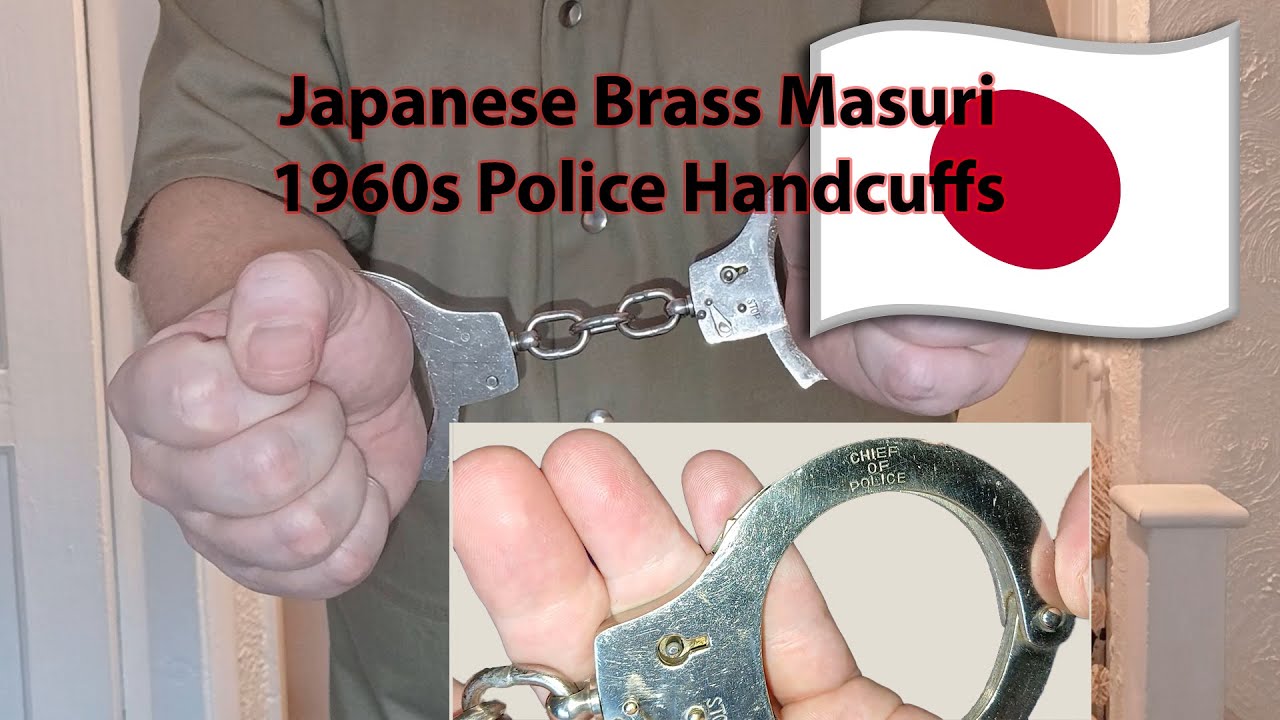
Japanese Masuri 1960s Brass Handcuffs (WW2 Design) with keyway curtain security & comparisons


This is a video primarily about the Brass Masuri Japanese 1960s police handcuffs. This design dates back to WW2 according to Alex Nichols' great books on handcuffs. These are not toys! , they are genuine police handcuffs.

The handcuffs shown in the video are 1960s Brass Masuri, 1980s Steel body Masuri, Steel body Takeda. The Brass Masuri are the main focus of this video and description. They are either nickel or chrome plated.

When you see these handcuffs, you probably think "They're toys" and that is because this style has been copied for years for the mass-produced toy market in China. These Masuri are the earliest brand known that made them and they are identical to a pair taken from a Japanese soldier in WW2.

This pair has "CHIEF OF POLICE" and "MONTE CARLO" stamping. It is not known if this means they were destined for Monaco police or if merely the association with the bustling rich casino locale was just a far-eastern marketing strategy to make them more appealing.

They have a pin wheel mechanism instead of pawls and are unshimmable. They do double lock with a stiff lever, which while provides no real liability protection for the user, it does serve the purpose of preventing accidental over-tightening better than any other version. Since this is the older brass model, it has a curtained keyway which is like a C shape cup, so you can insert the key and turn and the curtain / cup turns with it. This means picking them open is much harder because you cannot just shove a tool in and work with the mechanism, you need to precisely turn the curtain to the right position so that the opening would give you access to the keyway. And the keyway does not have much room to work with!

During Aparthide in Rhodesia (now Zimbabwe) they were under heavy sanctions and weren't able to get the latest and greatest security hardware from the west and elsewhere. So they used various handcuffs, including a steel version of these Masuri that I featured before and mistakenly referred to as Takeda. The steel model would have been cheaper because it uses stamped steel rather rather than all brass and is much cheaper and quicker to manufacturer. The steel versions are similarly great quality, though they lack the keyway curtain. But are still good quality handcuffs.

I concluded my previously featured steel pair and these Brass ones are both Masuri because of several factors. The quality is exceptional in both. Both have the same JAPAN stamp in the same location, with the same font, in the same size. On the back section, there is only one prominent artifact which is the base of the double lock lever's rotational pin. Both have 10 holes in the bow for sizing. Both have nicely welded chain links. On the other hand, the Takeda mentioned next have 9 holes, 4 prominent artifacts on the back, very shoddy construction, gaps between the body and cheek plate and a JAPAN stamp on the back, which is in a different font and different location, both matching what Alex's book shows for Takeda.

Then came along Takeda and copied the Masuri handcuffs and made them even more cheaply. Stamped steel bodies, still a brass bow, poorer construction, sloppy tolerances, thinner gauge material, poorly welded chain links (just on the corners of the poorly mated link ends) and the double lock levers have no stiffness, at least in my pair. These were later copied by China as toys. In fact in the 1990s I had such toy handcuffs as a kid, ones without the safety release on.

Weights:
Brass Masuri: 304 grams
Steel body Masuri: 278 grams
Steel body Takeda: 240 grams
And for comparison, modern decent quality toy versions, like Viper Tactical (in the UK) are 215 grams.

I believe the key I received is not the original key (I have seen several pictures to see the difference) but in fact is a Takeda key that works fine, slightly snug but works.

The on-body demonstration only shows these newly acquired Brass Masuri from the 1960s. I won't bother making a video on the actual Takeda since a) they are quite poor quality by comparison, look so similar to these and the previous Masuri and I have shown them at least in this video in the comparison.

Enjoy!
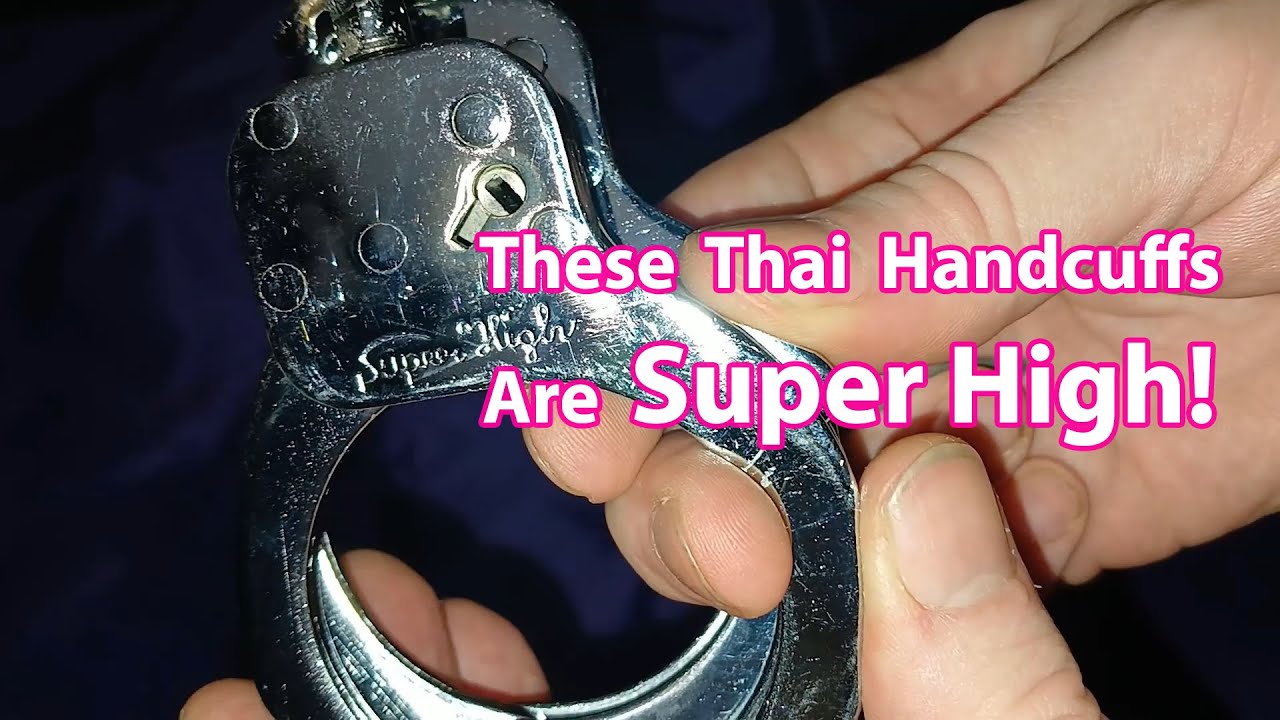
Thailand Super High single locking police handcuffs - Very shiny!


These are my first handcuffs from Thailand. They are marked Super High.

These are only single locking, they have no double lock at all. The mechanism is based on the Takeda / Masuri Japanese handcuffs, utilising a pin wheel mechanism with holes drilled into the thin edge of the bow.

These are all steel, likely plated with either nickel or chrome.

When I received them, the swivels were totally seized up. I had to use oil and pliers to work the oil in, to make them able to swivel. The swivels are not smooth but they do twist easily now!

The double lock on the Japanese Takeda etc models is almost pointless because of how easily both accidentally or intentionally, it is to disengage. So the fact that these Super High have no double lock, is a bit better than having one that is less useful than a chocolate fireguard lol.

Enjoy!

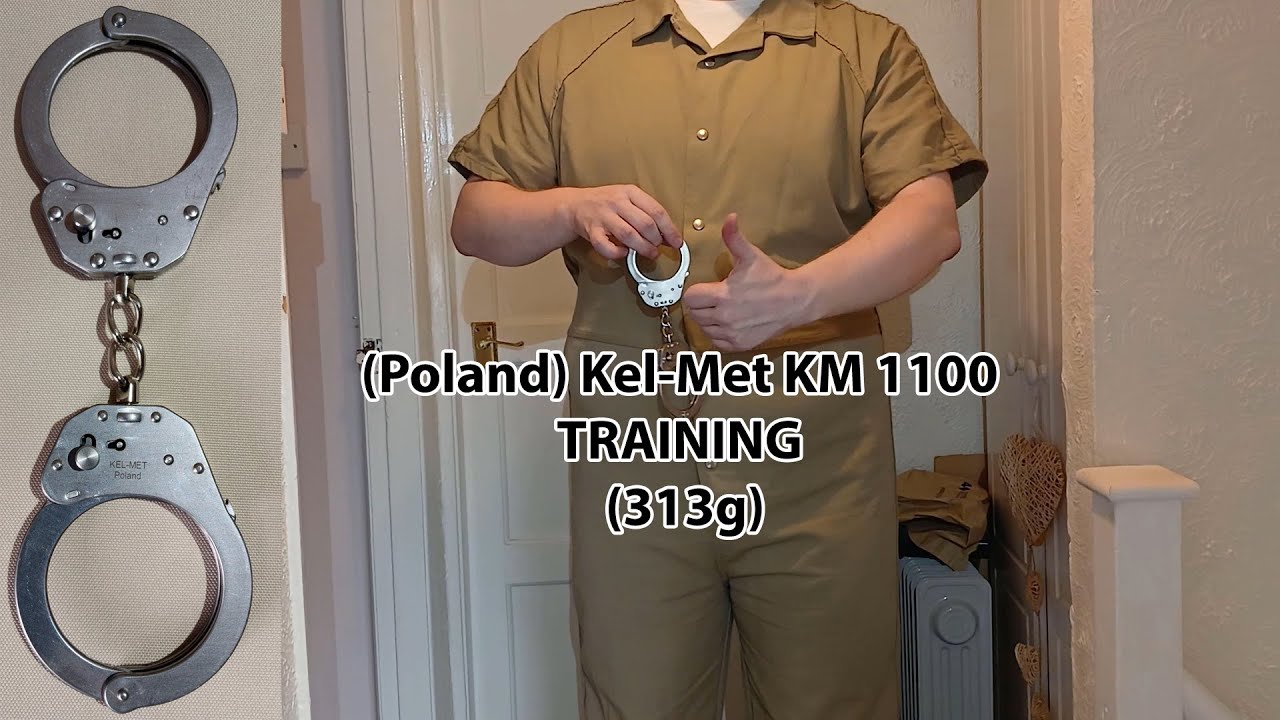
Polish Kel-met KM 1100 Single-locking Training Handcuffs


These are the Polish Kel-Met KM1100 training handcuffs. They are designed to aid in training officers/security/military on the application of handcuffs, with added safety in the training environment and with the increased speed of not having to deal with keys and double locks.

The fact that they have no double lock, makes this obvious to me that they are not for a complete training of complete standard operating procedure, despite how important double locking the cuffs is. This is clearly just about training people to apply the handcuffs onto the person successfully and then they will follow SOP after it's importance has been drilled into them over and over.

They are stainless steel (more skin-safe than typical plated handcuffs) and use only 1 pawl, since there's no need for multiple pawls for a training handcuff.

It's a nice handcuff and the slider buttons are fairly easy to operate on your own, for safety reasons.

One thing to be aware of is the slider buttons are actually screws. On my pair, one side was very loose and the other was super tight and I was unable to unscrew it even with pliers. But the other side was always loose so I just applied some blue Threadlocker and tightened with pliers and now it feels very secure from accidental unscrewing by hand contact. I would have used red permanent threadlocker but I have none. If buy buy a pair, ensure you check them to make sure they are tight!

I can imagine some people might use these within a bedroom context because of how real they feel (they are real cuffs...) but the fact that they have a super fast way to open them if need-be.

Enjoy!

An Early Smith & Wesson M100 (not 100-1) 1980 Police Handcuffs with PATS PENDING stamp!!!


These are the American Smith & Wesson model M100 handcuffs that came out about 1979. The patent wasn't granted until 1981, so the fact that these have PAT'S PENDING on means they are an early model, which is very cool to own!

These were the first time they had their new design of double lock whereby the internal spring also was the double-lock itself. These are stamped with their old Springfield location and soon after this they moved to Houlton.

Basically these are basically identical in function as the modern M100-1. The only real difference is the way the handcuffs are manufactured. Modern ones use rivets to hold everything together, whereas these old M100 have indents around the edge to help line the pieces up correctly and then heat, coupled with a special material added during construction sort of welds everything together. Apparently this older method was more secure of holding the handcuffs together. The modern rivet method is cheaper but still effective.

There was an revision of this M100 whereby the double locking window was not all the way through the cuff, but only was open on the front-facing cheek plate. But they quickly altered the design by having the hole go right through for easy double-locking from either side.

When I received them, the bow on one side was bent a bit and would not freely swing-through without being forced and the double strand was slightly bowed outwards. But I rectified this with a vise and a few bashes and bends by hand which gave these cuffs the chiropractic adjustment needed to function normally and healthily!! 😜

They seemed a bit hazy on the surface so I gave them a light once-over with some 0000 steel wool with some Autosol mixed into it and then after wiping the residue off I wax polished them, as is typical for me, with Renaissance wax. Of course I used some PMA Brake and clutch cleaner to blast out the internals before re-lubricating and cleaning them.

Lovely handcuffs! I wanted an M100 for years but when I found these and the fact they have PATS PENDING on them, since I found nothing else to buy I had to get these before anyone else.  About the only place I see these being used any more are on TV and movies, because the prop departments would have gimmicked them many years ago and never needed to throw them out with the little use they get.

Enjoy!

Japanese Takeda Police Handcuffs - Comparing the REAL police ones to modern toy copy versions


These are Japanese Takeda police handcuffs likely from the 1970s. The design is familiar to many, as a toy handcuff. This design was a genuine police handcuff, long before it was copied by toy manufacturers. There were solid brass ones and steel ones with brass bows. This is the latter.

The design of these handcuffs is very basic and to be honest not that great. It has a nice pin-wheel design that cannot be shimmed, but the double lock is merely a switch which easily and trivially can be switched one way to double lock and the other way to undo the double lock, making them not very safe from police liability.

These have welded chains, no rivets on the back and only 2 rivets or protrusions on the front to prevent the double lock switch going too far.

This design of handcuff is best known as being toy handcuffs and are sold all over the world, using lesser quality parts and lacking security considerations. For example the toy versions are made of more flimsy metal, they have exposed rivets to try and keep the things together and their chains are not welded, which means a strong person could pull or twist on the chains to get out of them. Also often the swivels on the modern toy versions are longer, which makes them more likely to snap.

This pair of actual Takeda handcuffs was used by someone in the Rhodesian BSAP police force. However it is a Japanese handcuff and even has JAPAN stamped on it near the swivels (not sure if I got this on video).

I thought this would be a somewhat interesting video to show you a pair of "toy" handcuffs that are actually not toys and were officially used by police forces and compare them to actual modern day toy versions.

Enjoy!

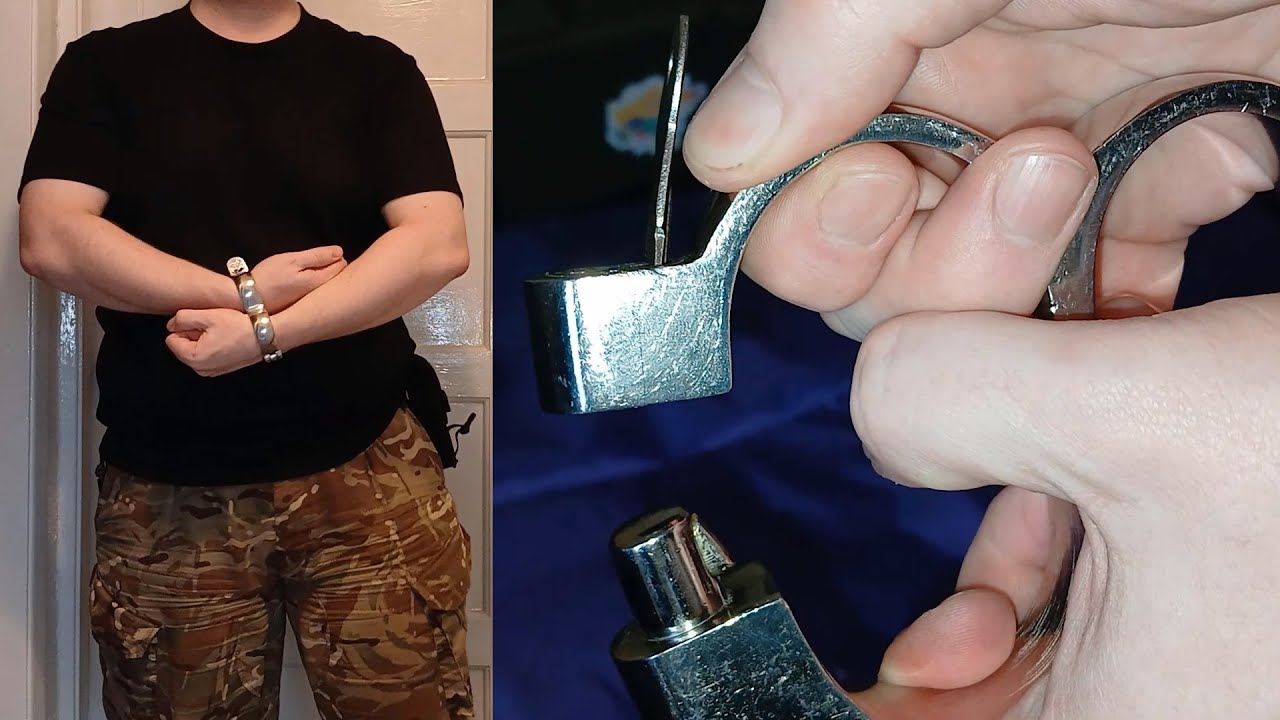
Victor Works Model 1035 Irish 8 Rigid Handcuffs with Hamburg 8 Locking Mechanism


These are the Victor Works model 1035 Irish 8 style handcuffs with a Hamburg 8 locking mechanism. I am unsure of the age of these, but I do not see VW often at all.

These are a solid, rigid handcuff that have a somewhat simplistic locking mechanism. The key is basically a shim by any other name. The key is pressed into the keyway and this is enough to unlock them. So if you have a flat-head screwdriver, you can also disengage the lock. So, not very high security UNLESS they are applied adequately. If these are placed on someone in a rear stack position with the keyhole facing downwards, it would make escaping very difficult. The key is hard to insert by hand and the more outward force is placed on the cuffs, the harder the key is to press into the mechanism to unlock them. So the best way to unlock these yourself is to get the key into the hole and then relax all force on the cuffs and press the key down inside using your chin or a pushing up under a tale top etc so that you're not struggling against the cuffs while pressing the key in.

For a larger person like me, if you put rigid cuffs like these on with your palms facing each other, it is very restrictive because the more you pull your arms in towards you, the more your arms need to separate, which the cuffs won't allow. So it can be painful and maybe even snap bones if you try too quick or fall down while wearing the in such a position. SO be warned! Stack positions are most advisable. I demo a front stack but if you do the same thing behind the back that should also be safe.

This is the first example in my collection of Victor Works, which is nice. Also the first Hamburg 8 mechanism that I have. They are made in Pakistan, similarly to KUB or KUBIND handcuffs and leg irons etc.

A very restrictive handcuff, like the two KUB rigid ones I did videos on prior.

Enjoy!

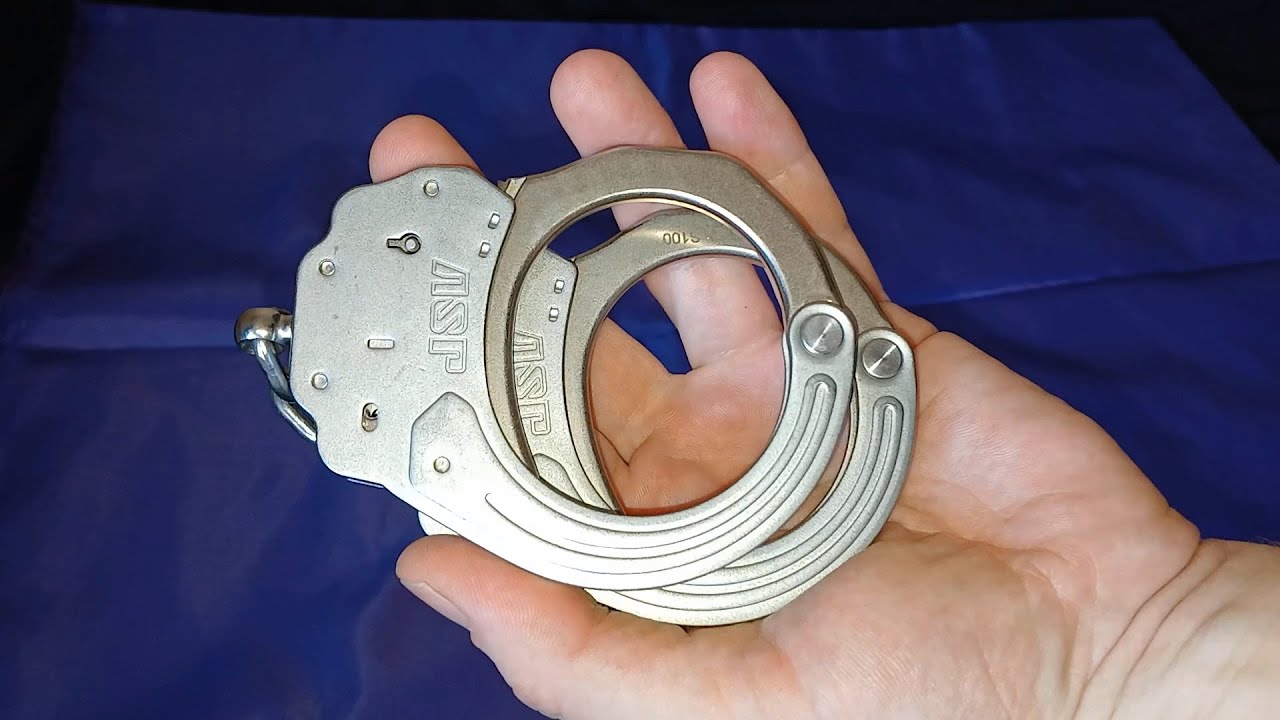
ASP S100 Sentry Chain Police Handcuffs In All Stainless Steel ~ ASP Features at Lower Cost


These are the ASP Sentry model S100 chain-linked handcuffs. These are the first in a lower cost or budget line of restraints that provide some nice ASP safety and quality of life features, at a lower price point. VERY worth the purchase for LEO officers and security etc. They weigh 348 grams, which is more heavy than the 288 grams statistical average weight of handcuffs of this style in my collection. But they are robust and have features that are worth it, in my opinion...

With ASP you get smooth edges, double locking via the slot window and via the keyholes, keyholes on both sides and these Sentry handcuffs also have these features.

You get very smooth action which is almost guaranteed every time to engage the bow when applying the handcuffs, even when not much force is applied, making manual tightening easier.

They have a single pawl, like the yellow double lock window models of their higher end and previous models. Another plus about modern ASP handcuffs (I think the more expensive Ultracuffs have this too) is these chain cuffs are more resistant to chain-binding attacks. Chain binding attacks are where someone in handcuffs can literally snap the handcuffs and escape by binding the chain on its self and applying force with their arms and snap them. These Sentry (and as I said, I think the others too) have a special system which reduces (or maybe prevents) this from happening... Something to consider.

There is a downside to Sentry models, which is almost a non-issue due to their construction! With Sentry models, you cannot replace the locking mechanisms or "lock-sets" as they call them. However... These Sentry are all steel, like any other police / regulation pair of handcuffs, whereas every other ASP metal handcuff, including the high end Ultracuffs have plastic internal parts which can break. So it makes total sense for the ultracuffs to have the facility for owners to buy and replace their lock-sets at will, to reduce costs and prolong the life of their handcuffs. Since these are all steel, there is no plastic to wear out or get damaged any faster than any other totally metal handcuff like Smith & Wesson or Peerless.

So, why bother with Sentry if you have a profession where you already have handcuffs? Lower chance of injuring someone, easier size adjustment since you can re-double-lock the cuffs via the keyway instead of having to remove the key and re-locate the DL slot window and these cuffs engage quicker and easier than almost any other brand. The only brands I know that can rival the smoothness on these are Alfa-Proj (which have the flat keys) and Kel-Met.

These are very worthy to be purchased by any and all LEO police or security personnel who want a really good quality handcuff, with additional safety and convenience features at a more affordable price.

These will fit in more cases than the more expensive Ultracuffs from ASP since they are a tad thinner.

Designed by ASP in America, these are manufactured in Taiwan, but by a company who does a FANTASTIC job of manufacturing handcuffs, clearly. These are not cheap rubbish, these are the real deal.

Enjoy!

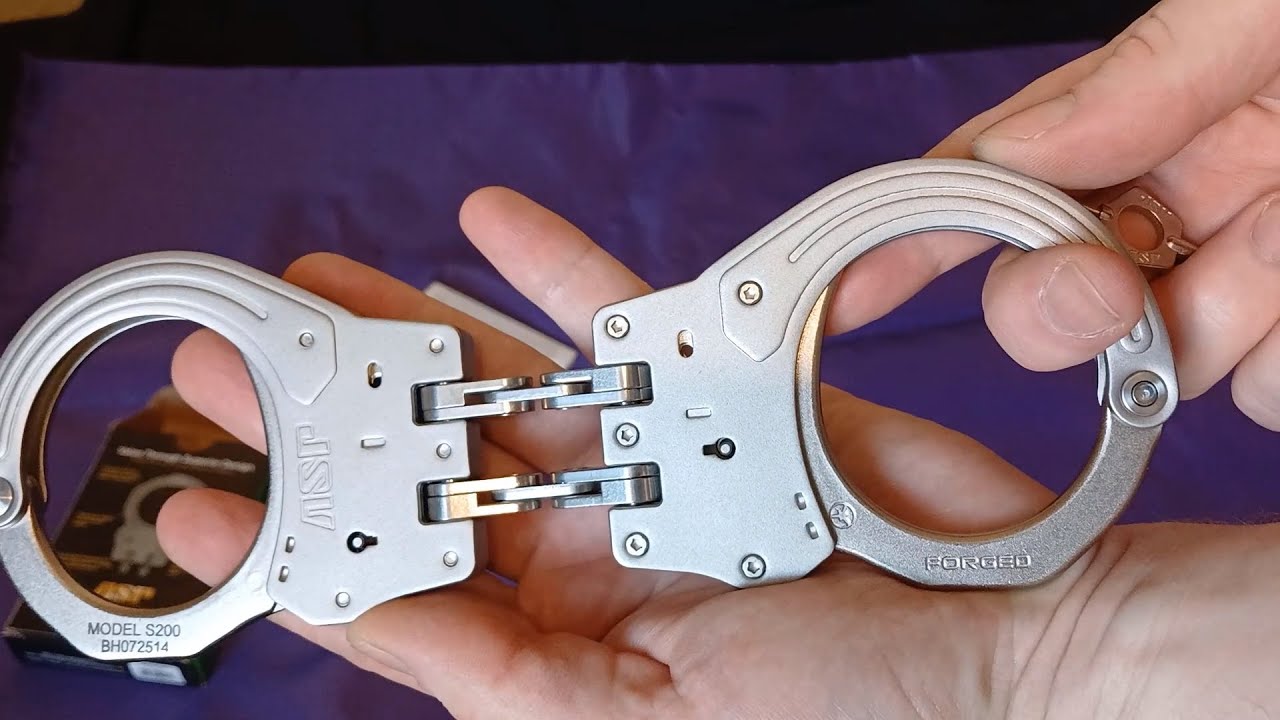
ASP S200 Sentry Hinged Police (all steel) Handcuffs Latest Model! More robust & more affordable.


I think I have the world's first YT video overview of these Hinged model! I have searched and found no videos on the hinged version at this point. These are the hinged Sentry S200 handcuffs from ASP. They are designed by ASP in the USA and are built in Taiwan to exacting US standards. It is a high quality handcuff, not unlike Chicago brand handcuffs which are also police-grade and made in Taiwan. Not all Taiwan handcuffs are great, but ASP and Chicago most certainly are VERY good quality indeed. These weigh 393 grams, which is a tad above the statistical average of 347 grams weight for other hinged handcuffs in my collection. However the features you get are worth the extra weight in my opinion...

These are made from all steel construction and are a more cost-effective cheaper way for police and security etc to get some of ASP's really nice features, instead of having to fork out for the more expensive models. They are basically the same as the yellow double-lock window handcuffs. They have only 1 pawl, like Smith & Wesson or Peerless do.

These have the smooth surfaces to reduce injuries, double locking via both the slot window and also the keyway. This keyway double lock access makes it quick and easy to adjust handcuffs that are too tight and quickly double lock them again once adjusted. They also are exceptionally smooth in operation, meaning that even if minimal force is applied, the chances are almost guaranteed that the bow will engage, making it easy for you to then tighten by hand. They are really nice, as you would expect from any ASP handcuff. As usual they have keyways on both sides of the handcuffs, so you can always easily get at keyholes.

They are slightly thinner than the Ultracuff, more expensive models, which means you have a better chance of fitting them into a regular pouch or holder than you would with the chunkier ultracuffs.

I really, REALLY like these. Nice weight to them and they feel great quality. I can speak from experience of having ultracuffs to compare to and I can honestly say that if I were in an occupation where handcuffs were a required tool, I would at minimum want a pair of these on hand because of the minimised chances or injuring someone and the other conveniences.

One downside to this more budget range of ASP handcuffs, is that you cannot replace the lock-sets. These are like any typical Smith & Wesson or Peerless handcuffs etc, where you cannot disassemble them. The more expensive Ultracuffs and UltraPlus Cuffs can be disassembled to replace the locking mechanisms if they get worn out. This is important with ultracuffs, as they use plastic parts inside the mechanism. These Sentry are all steel, so it makes sense that you wouldn't even need to replace locks on these anyway!

An excellent, high quality budget ASP handcuff that has a lot to offer.

Enjoy!

HIATT 115 Scotland Yard Adjustable Darby Handcuffs - A Later Alloy Version?!


These are the Hiatt 115 "Scotland Yard" adjustable darby handcuffs. My existing pair is gimmicked, meaning they pull open. So now I have a non-modified original pair to put in my collection so that I can pull my gimmicked ones out and keep them separate with the rest of my gimmicked cuffs.

I have not done an on-person demo of these because the springs are very strong and hard to operate with one hand.  

They are basically a darby style handcuff which has a ratchet so that they can close smaller and smaller to fit the wrist size of the wearer. It was a great idea, but since the mechanism has to be exposed by the open hole at the bottom, it is possible to stick thin objects in and release the handcuffs without having to use the key. They were not super popular from what I have heard. Standard Darby non-adjustables were preferred for a very long time.

This pair is from perhaps the 1970s or 1980s, as they are not steel. They aren't the grey ones which were more cheaply constructed, but a better version. Non-magnetic essentially (very very slight attraction, maybe from the plating). Almost as heavy as my all-steel ones.

I was hoping to get a pair from the early 1900s to go into my British Police Cuff Lineage box, but these are legit and will serve the purpose of filling a gap in my collection.

I'm glad to have a non-gimmicked pair in my collection!

Enjoy

A quick look at some cheap eBay HIATTS 2050 Hinged Handcuffs that I gimmicked / tricked out


This is just a quick look at a pair of Hiatts 2050 hinged handcuffs that are gimmicked. Basically they are identical to the recent TCH hinged handcuffs I did a full overview on. I got them cheap off eBay for the purpose of having a look-alike hinged handcuff which is gimmicked. The only real differences are the edges are slightly less harsh and the branding stamp says TCH instead of HIATTS, but aside from that they are identical.

Gimmicking is a modification process that means you can pull the handcuffs open without having to use the key. This gimmick is sometimes referred to as "Bridge Jumpers" after this style was used when people jumped off a bridge and escape handcuffs in the water. It's a really, really stupid simple gimmick. It would not pass inspection in close up magic. Not only are the teeth filed at a non-normal angle (which only a pro would notice) but you always hear the cuffs open with a Zzzziiiipppp when you pull them open. So not very covert.

Gimmicked handcuffs are routinely used on TV and in the movies, for health and safety reasons. This way if there is an emergency on set when actors and extras are handcuffed or leg cuffed, they can get them self free in an instant. They can also be used as safe props for stage work, used for costume and related cosplay, pranks etc.

I go one step further and modify the double locking push-pin activator to ensure if someone were to borrow them and use them, the wearer cannot get "trolled" by someone jabbing a paper clip into the double lock activator and get the person stuck in them. To do this I use a rotary tool with a conical grinding bit to widen the hole at the exterior side. Then I clear the hole using PMA brake cleaner to ensure it's free from oil/debris etc and I plug the hole with Steel-Stik, which is an epoxy putty. Once it cures hard, you cannot push the pin to double lock them. Imagine trying to push an avocado through a little kitchen funnel. It won't press in any deeper. You can visually see this at this timecode on the video 00:24 and 01:11

Making these gimmicks is a pain, because you need to repeatedly test each tooth over and over again after grinding and make sure every tooth is decently enough perfect so that random rare hang-ups where they glitch out and stop pulling open at some point are prevented. If a glitch like that were to happen you'd have to jostle them about and try again or tighten by one click and then try to pull open etc. So perfecting the grinding or filing of the teeth is very important.

I always like to have some gimmicked handcuffs on hand because they come in handy for experimenting picking or using keys in various cuff positions, knowing that if you screw up,  you can get yourself free. Also friends/family/colleagues around here could borrow a pair if they were going to some fancy dress thing and wanted some more legit handcuffs for their costume that look and feel real but are safer to mess about with lol. Never happened yet, but always nice to have!

Enjoy!

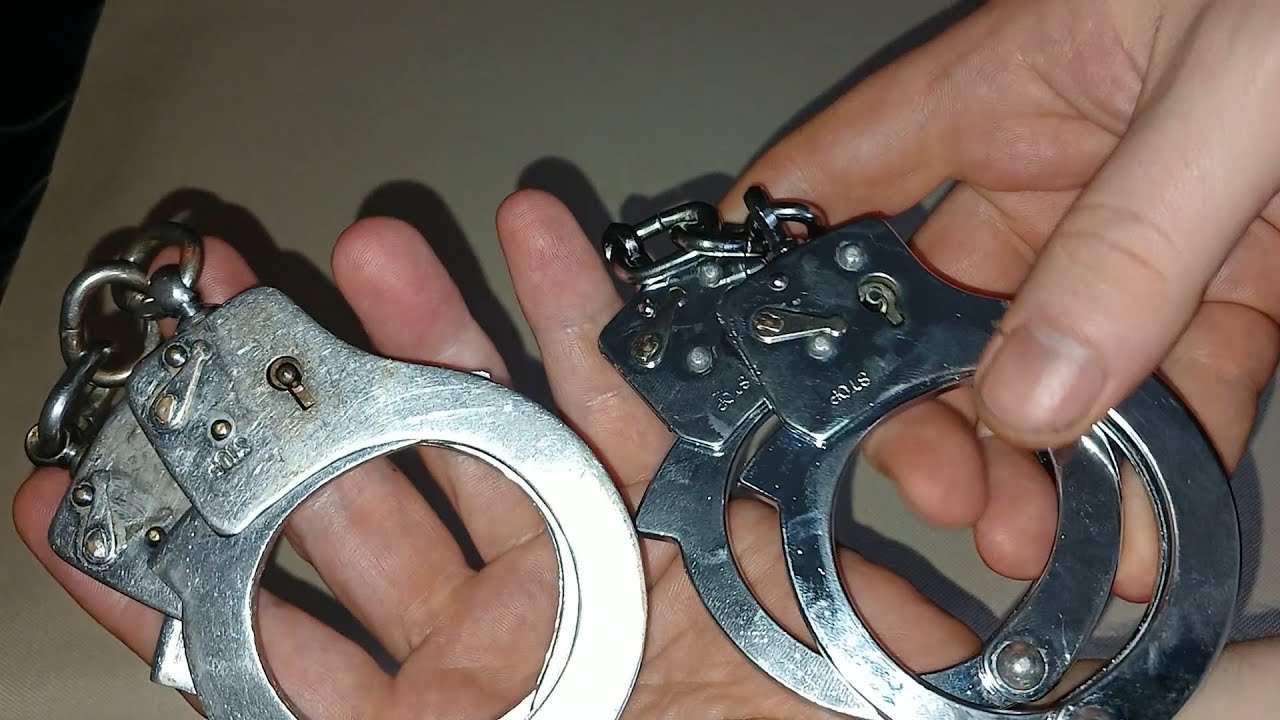
J.G 1950s KE 2770 British Military Darby Handcuffs (stamping ground off 😭)


I had a pair of these J.G British Military handcuffs a while back but sold them because they were too small for me to comfortably demonstrate for people.

I was holding out that a larger size would be available but they seem to be always small. Since I had no other false back-strap handcuffs, I decided to get another pair. But unfortunately some military jobsworth ground all the branding and military signage off the cuffs before parting with them. They even ground off the contract number and broad arrow off the keys!!?! 🤬 There are tell-tail traces enough that based on my prior experience I can tell they are J.G and the same KE 2770 contract, however other than detecting that they are from the 1950s (like most I have seen) I cannot tell which specific year in the 50s they come from. It is just loopy beyond comprehension looking at.... well lets call it what it is DEFACEMENT of these really nice handcuffs. You'll see me make a curly gesture going off screen lol. My god. I just can't believe someone would do that. They aren't even personally identifiable markings to any individual. Anyway..

I really like the design of false back-strap because I feel like they are more rugged than a riveted design. Shockingly these are heavy! They weigh 617 grams! The typical darby style handcuff is about 400 on the top end, so these are up there in the meaty category, especially considering I can barely close them on my smaller wrist. It's a lot of metal for a small-medium wrist size cuff...

Over all I am really, really happy to have a pair back in my collection. I will put up with them being small, just to have this design back in my collection. Though, if I find a better looking pair at a decent price in the future, I may swap them out for a better looking pair with stampings intact.

Enjoy!

TCH 810 Hinged British Police Handcuffs


These are model TCH 810 hinged handcuffs from Total Control Handcuffs (TCH).

As I understand it, these are sometimes carried as an additional or backup set of handcuffs by police. They are more restrictive than the older style chain handcuffs but not as restrictive as rigid handcuffs. They have the usual 3 pawl bar system and push-pin double locking.

This is the standard size, so they can close to a smaller size and won't accommodate very very large people. Modern speedcuffs have the larger "superior" size. So I got these to have the comparison.

They have a very, incredibly strong, 3 bar hinge system. This provides, in my opinion, SO much more strength and mechanical security against brute-force escape attempts. There is a video of someone snapping a peerless hinged handcuff in half that he was cuffed to an interrogation table at the police station in the US. I do not think that would ever work with these TCH hinges.

They are very nice, a matt less reflective nickel finish. Older models of TCH tended to be very very shiny, but I have noticed as time has moved on, they seem to be doing everything in a matt, almost "Smith & Wesson" style nickel finish.

Very high quality. Though unfortunately in my case the brand stamping is not properly formed.

A really nice addition to my collection. I have not had a standard-length TCH hinged in a long time. Perhaps one day I will get a HIATT version. That would be nice! I do have the extended hinged model though, that you may like to check out.    • 🇬🇧 Somewhat rare TCH 860 Extended Len...  

Enjoy!

KUB Kubind KB-917 Large Irish 8 Handcuffs A Recreation Of Old UK Design.


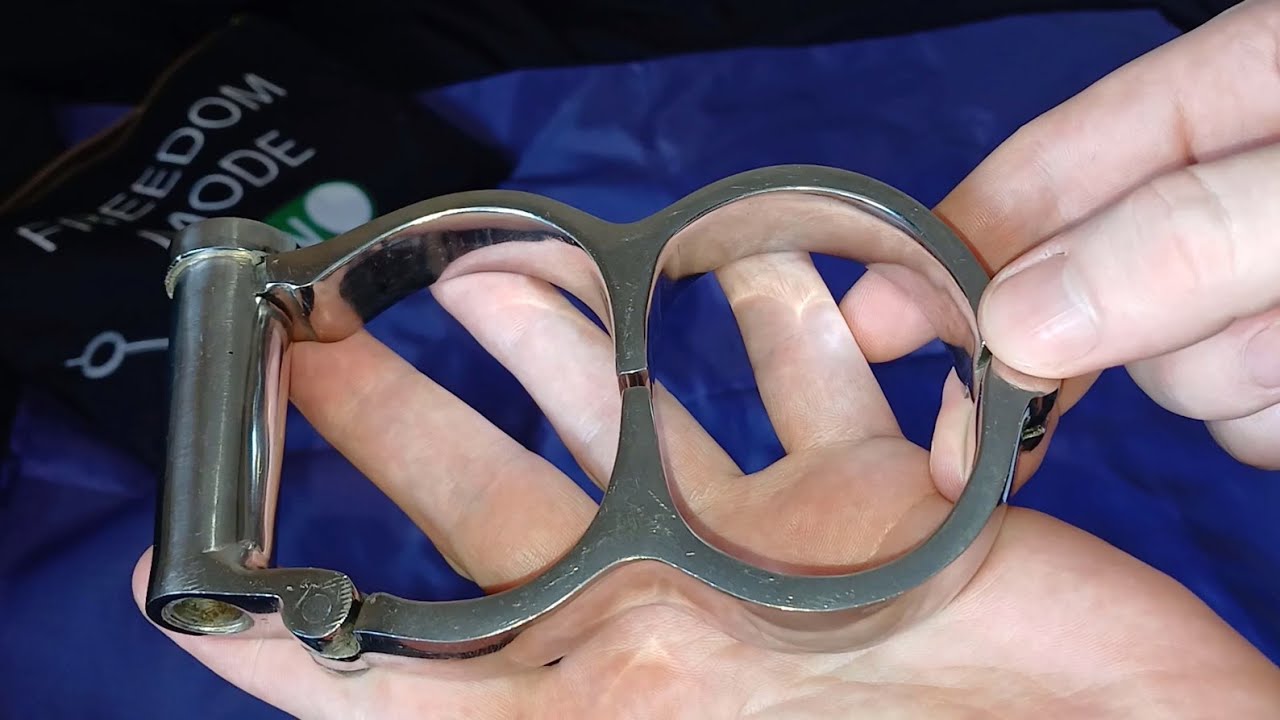
These are a rigid handcuff from Kub in Pakistan, based off the classic Irish 8 with Darby locking mechanism. Prior to the invention of the Darby locking mechanism, they used a special nut and key in the Plug 8 model.

Though this has a classic style of Darby locking mechanism, no other Darby key I have will fit. It will bite a very slight bit, that in an emergency if you lost your one key you might be able to pull against the spring and get them open. But only Kub keys will fit this handcuff, based on my experience.

The spring is not too strong, which is nice. There are 2 hinges, because not only does the main part of the shackle need to fold down over the wrists, but then the other hinge is so that the locking tube can swing into position and lock. They snap shut and are locked without having to use the key, like most Darby handcuffs.

Very restrictive! I have a pair in the Large Men size (according to the official box). I have somewhat large hands and take a large or extra large Nitrile glove. My right hand & wrist are larger than my left and in the largest side of the handcuffs (closest to the locking tube), I can spin either of my wrists around in that side, which helps to use the key to get out of them without needing help! But if you have a more snug fit, you might struggle to get out of these handcuffs without having another pair of hands to help out...

I do not have any genuine old Plug 8 or Irish 8, but at least I have modern, good quality representations of these two styles of handcuffs from this Pakistan company Kub aka Kubind. Genuine old ones, such as by Hiatt, tend to be quite expensive.

Enjoy!

Smith & Wesson M100P-1 Long Chain Police Handcuffs ~ (Tested behind back also)


These are the Smith & Wesson M100P-1 handcuffs which have a longer chain for use on longer individuals.

Instead of the window design, they use the older push-pin style of double lock. I feel this is more secure because of the many and various attacks on the mechanism that are possible via the window style.

They have a single pawl mechanism like all their other cuffs, but given that suspects/criminals should be searched and not left unattended, it's not normally a major problem that a cuff doesn't have more fancy security measures.

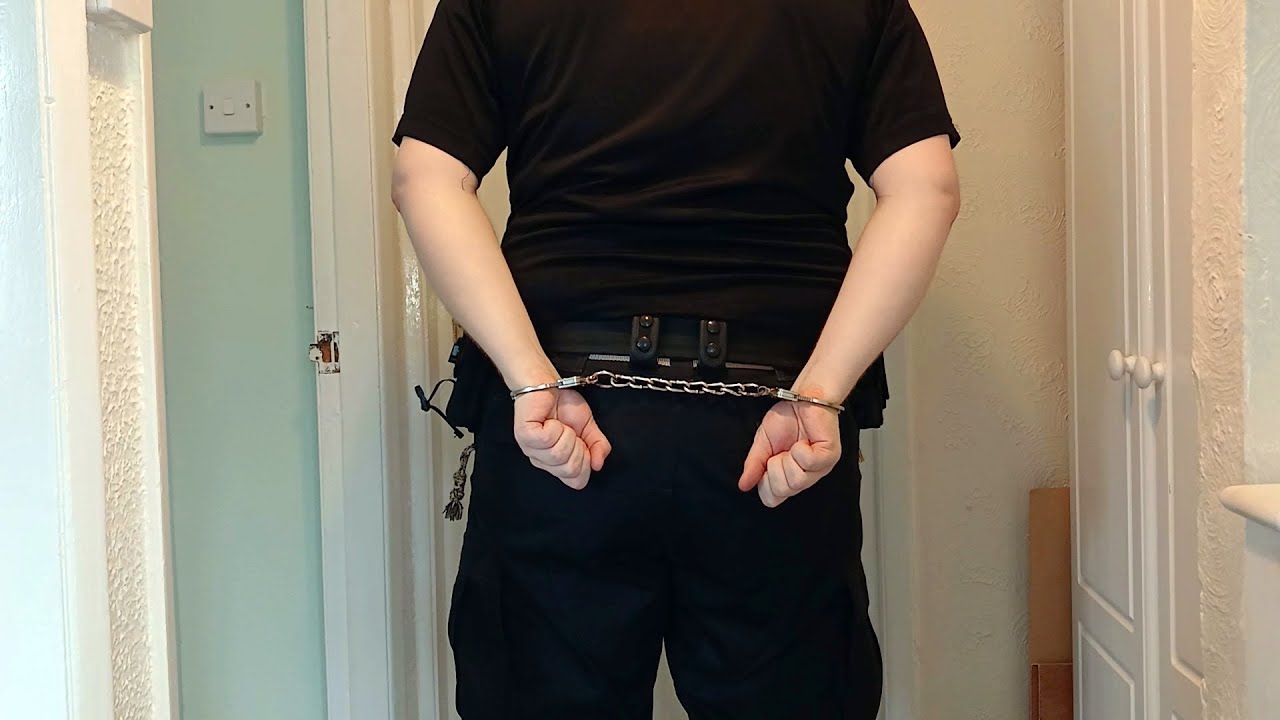
The added chain length is useful for use on larger individuals that might otherwise require 2 pairs of handcuffs to be linked to extend the length. I tested them behind my back and they are more comfortable! However, this length also lends themselves to being used for carrying important and expensive goods in cases, to ensure that merely snatching a bag or case from someone would not liberate it from the owner. But in this situation it would be of basic grab & run protection, since anyone with a standard key could take the handcuffs off the bag or case if they had the time or threat of violence etc.

Of course some people use these in the bedroom, since they are longer, they adapt well for use on bed headboards and posts etc, as seen in the Stephen King movie "Geralds's Game". The ones used in the movie were the version that used smaller chain links (so there were more chain links) but the same 6 inch length. It probably should go without saying, but if you use handcuffs in the bedroom, always use them safely and verify the cuffs work and that you have more than 1 key around!

As you would expect from S&W these are great quality handcuffs and feel very smooth to the hand. Very shiny too. Not mirror shiny but they reflect light in a nice way (especially when you wax polish them as I do most my handcuff collection)

Enjoy!

Smith & Wesson Model 90 Police Handcuffs From Late 1970's / Early 1980's


This is a pair of Smith & Wesson Model 90 handcuffs. They were used in the US by police (probably military police as well). I am not sure when this model was first manufactured but it would have been probably early 1970's or perhaps earlier. The airweight model 925 was modelled on these and I believe 925's were around in the late 50's so... chicken or egg. Not sure which came first but I do like these model 90.

They stopped manufacturing these in 1979, I believe. Based on the design nuances and serial number of mine, it would track with the original sellers claims that these were bought in the US 40+ years ago.

This pair has some interesting professional stamping of DFC and A / A which I do not know the meaning of. But there is also a owner-engraved number on there which fits the format of a US Social Security number. Apparently the US military used SS numbers for identity for a long time, so it makes me think these were possibly owned by someone in the US military. Given this context, if you know what DFC or A / A means, please comment below.

The mechanism is very strong and in amazing condition. I did have to use some 0000 steel wool to get some gunk off and then do my usual cleaning and maintenance steps to ensure proper working order.

I really like these! Very smooth feeling and yet have all the required modern features you would want, including the indent system for the bow which bites and holds the bow in place in case a very strong person tries to escape by pulling outwards.

Enjoy!

Scarce / Rare Smith & Wesson 926 Airweight Lightweight Aluminium 1970s / 1980s Handcuffs


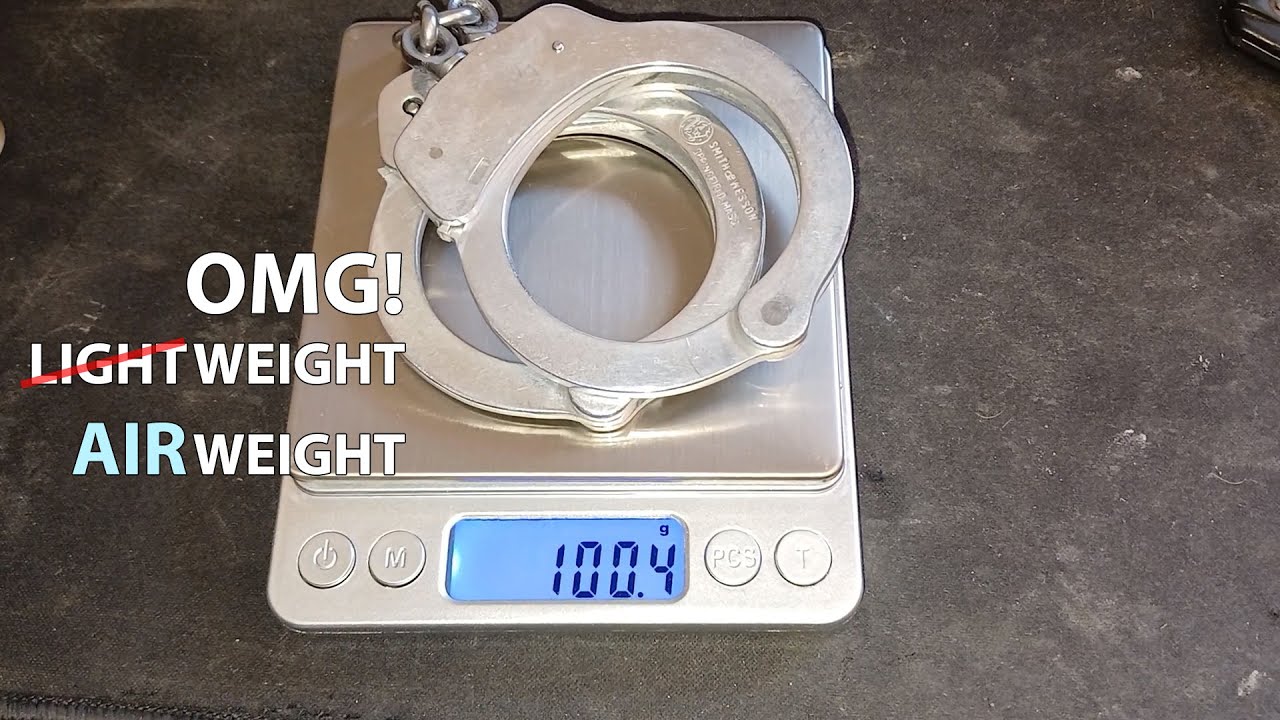
These a pair of lightweight (known as airweight due to the extreme lack of weight) Smith & Wesson 926 chain link handcuffs. They are made from aluminium or aluminum and are exceptionally, extremely, ultimately, ludicrously light at 100 grams!

These have a single pawl like most S&W handcuffs and has the usual double locking. This is an old pair, likely from the 1970s or 1980s but in excellent like-new condition, pretty much. The bow teeth are still fully intact and sharp!

To see them, you might think they were a model 90 basic old S&W handcuff, but the rarity of handcuffs in this weight-class is where they stand out. These are so light, lighter than even Peerless 730 Superlite. They are so light people would swear they are toys. They weigh absolutely nothing. If you put some fur on these from a toy set of handcuffs and warm the handcuffs in your pocket to body temperature and hand them to someone, they would absolutely believe they were toys, not a hard to find expensive pair of handcuffs from one of the world's best known gun manufacturers!

I got a great price on these from @MrHandcuff . Normally these can be anywhere around £150 / $200 etc. While not strictly "rare" they are very 𝙫𝙚𝙧𝙮 hard to find. This model was manufactured somewhere between the years of 1958 to 1979, though not in as large batches as the regular steel handcuffs, making them harder to find.

HIATT in the UK made a similar extremely lightweight handcuff, based on the 1980 pattern handcuff, but due to the larger costs to make them, they opted for less and less aluminium and more of a steel alloy which is lighter than normal handcuffs but not as RIDICULOUSLY lightweight as their early models, like this Smith & Wesson pair.

I used some very fine wire wool to clean some tarnish from the top side near the swivels and I polished with Peek cleaner and Renaissance wax, as well as lubricating with WD40 Specialist Dry PTFE (do not ever use graphite on aluminium handcuffs!) They are amazing!

At this moment they are not featured in my collage/tower image of my handcuff collection, but I shall be doing that as my next task once I get some time to set everything up.

Enjoy!

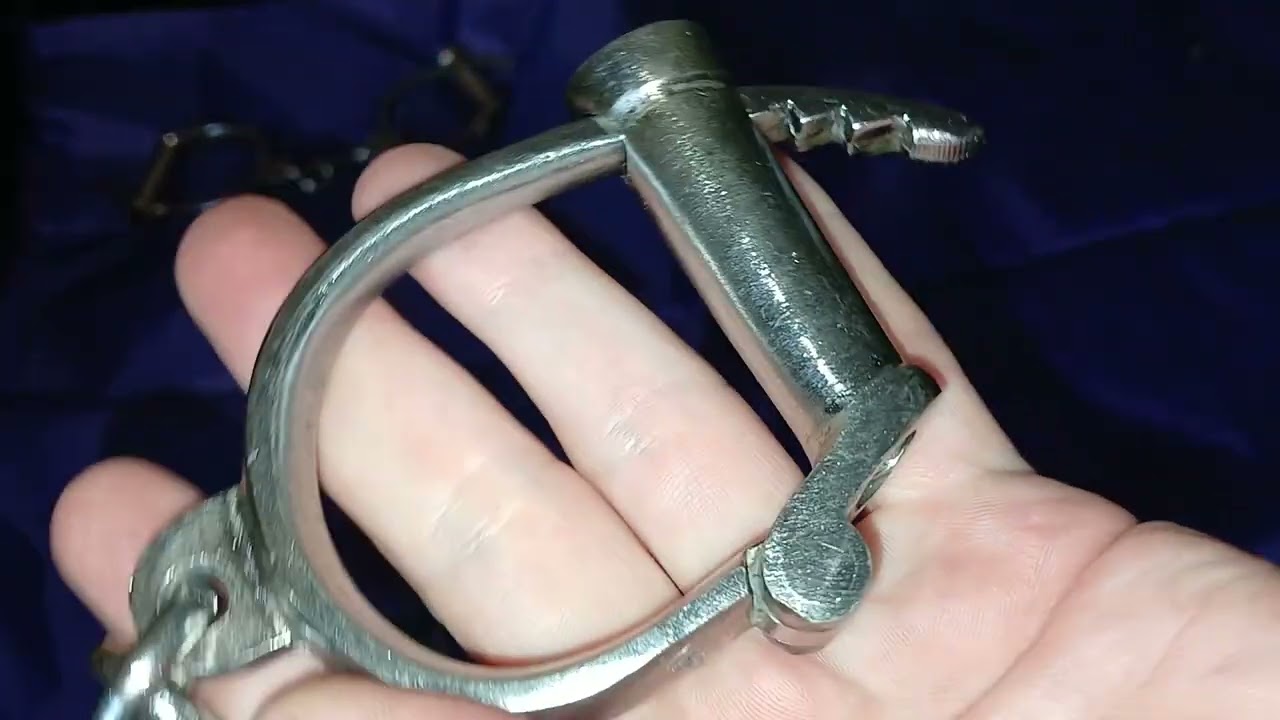
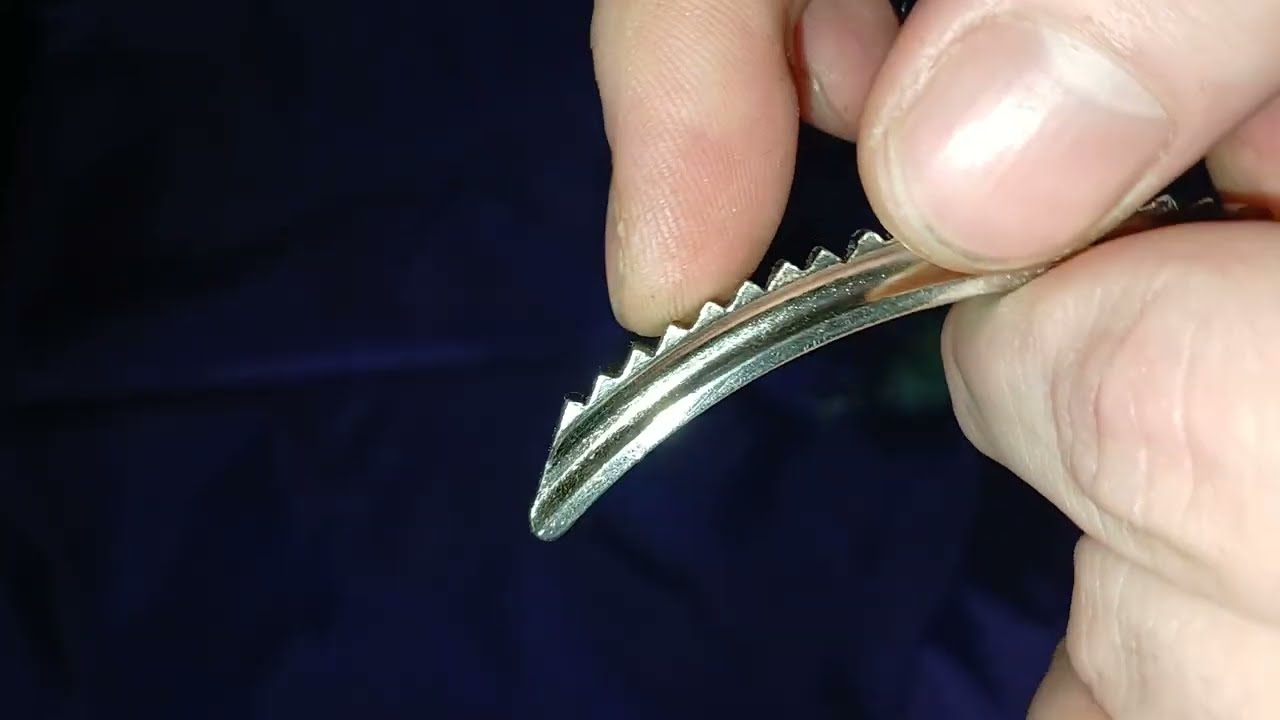
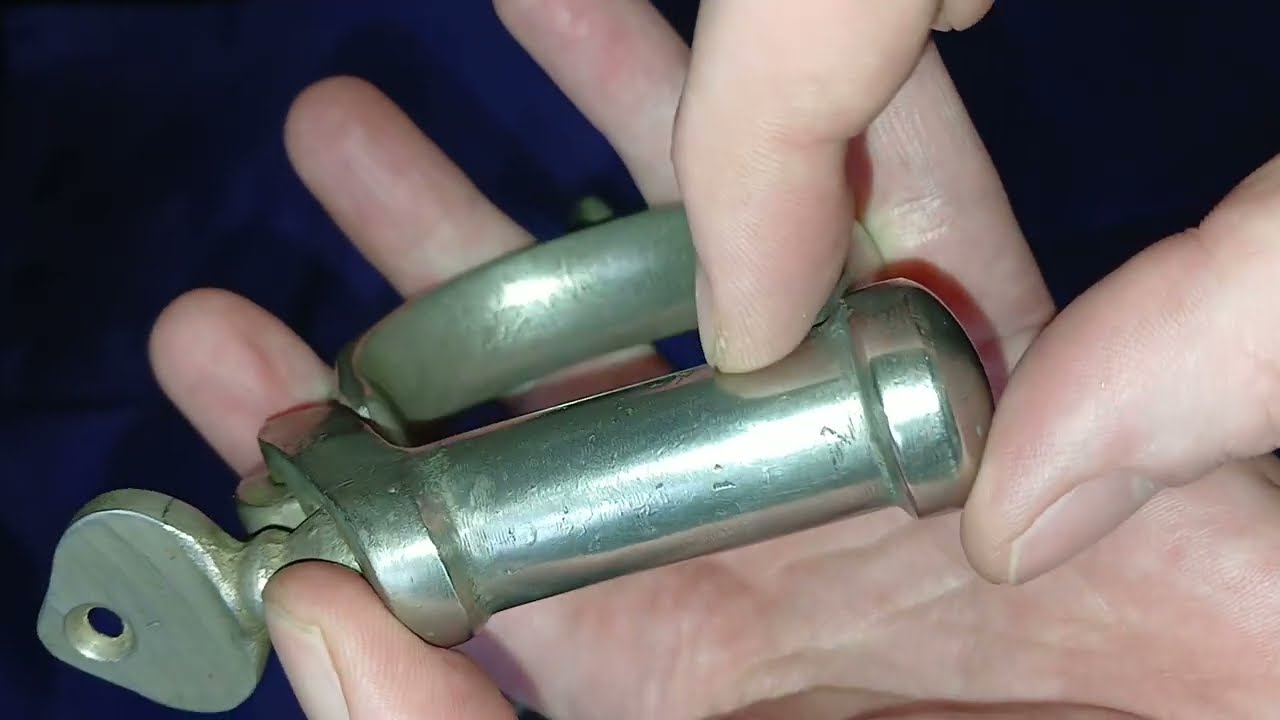
HACKETTS Nipper or Come Along from early 1900s or perhaps late 1800s


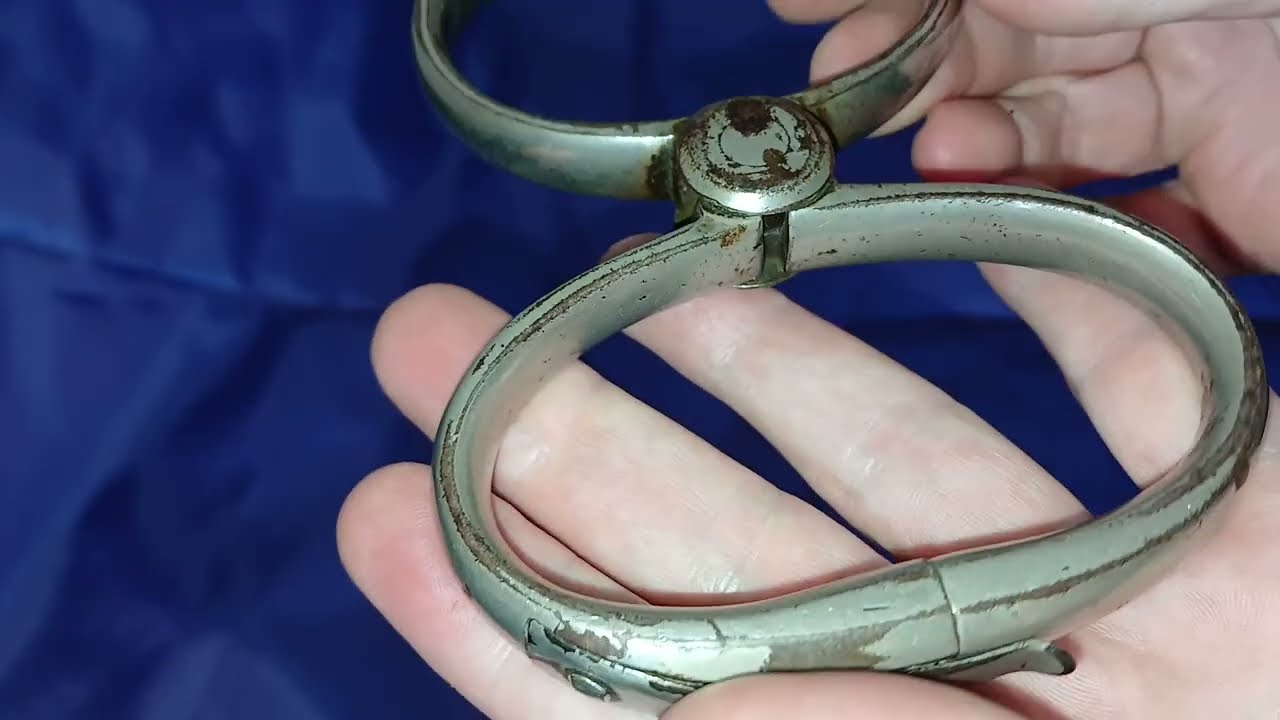
This is a one-handed restraint known as a "come along" or "nipper", which is a type of device to restrain one arm and maintain control over someone to guide them to where you want them to go, but having the ability to apply pain or break the wrist or forearm if they struggle. It was an alternative to using handcuffs, when people were less likely to be violent and need fully restraining.

This particular one is referred to by Hiatt as a Snap, because it closes with a "snap!" However this does not appear to be made by Hiatt, it has HACKETTS stamped on the top of it. Basically nothing is known about this manufacturer or brand, but this particular Come-along I have was owned by the great grandfather of the seller, who was a policeman in Cheshire, England at the turn of the 20th century (very early 1900s, probably a bit before too, since we are talking about the father of the seller's grandfather being the original owner..)

A nice interesting alternative to handcuffs, that I thought I would share with you.

𝗔 𝗯𝗶𝗴 𝘁𝗵𝗮𝗻𝗸 𝘆𝗼𝘂 to @CoxysPicks for acquiring this nice and unique addition online, to add to my collection. I am not sure if I will include it on my handcuff collection images, because strictly-speaking it is not in anyway a handcuff, as far as I am aware. But I am 𝘃𝗲𝗿𝘆 happy to have this 😁 .

Enjoy! 🍻

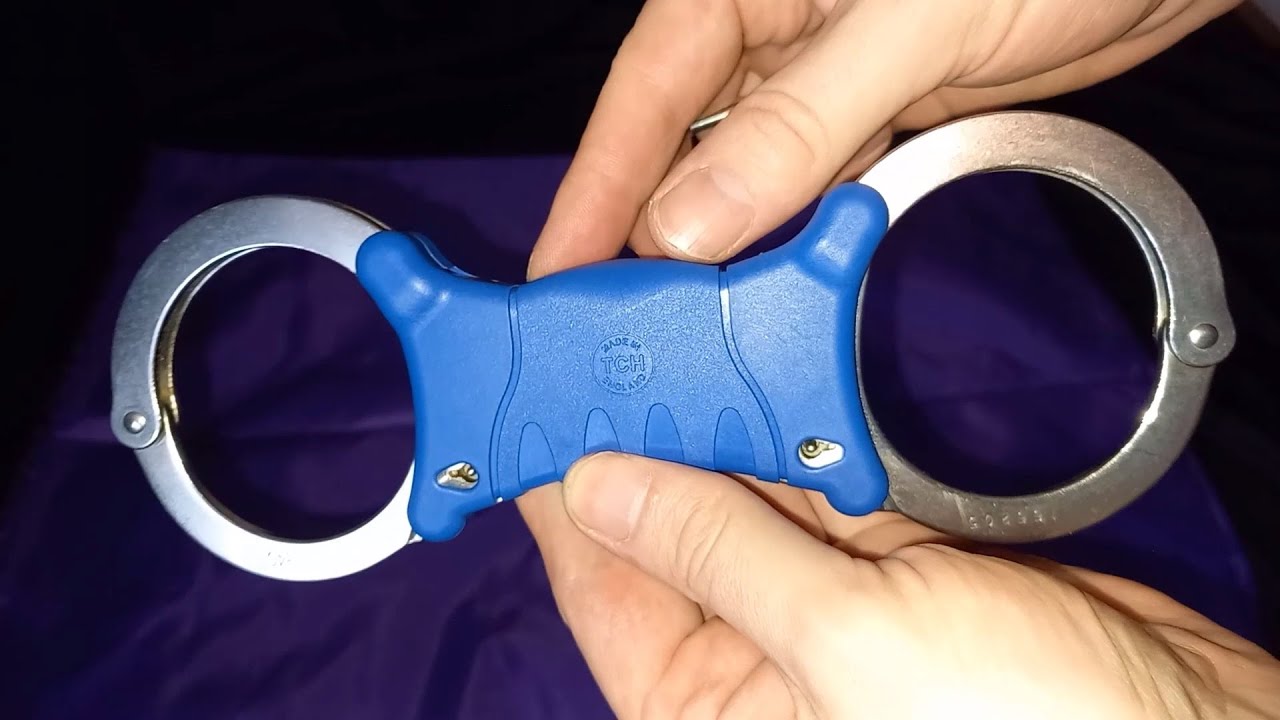
TCH 840 Blue Rigid Speedcuffs Northern Ireland Police Handcuffs


These are the familiar TCH 840 rigid speedcuffs, which have the Northern Ireland blue coloured gripping area.

I have not seen these handcuffs in photos very often but it's a known thing that these were for Northern Ireland. I have seen video footage where they were worn on officers belts, but I was never able to find this again on YouTube.

They have 3 pawl bars and all the other usual TCH features like back-loading and double locking.

The number of colours that TCH 840 speedcuffs come in are black, red, blue and yellow. Black are standard, as used by most police forces. Red are used during training which clearly identify the person in them is not actually under arrest. Yellow have been used by private security, to signify they are not impersonating a police officer, since they do not have the typical black colour. Blue is for Northern Ireland police.

Enjoy!